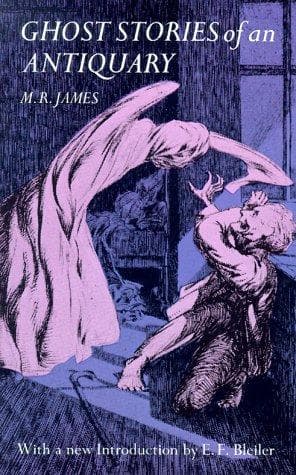
Ghost Stories of an AntiquaryJames, M. R. (Montague Rhodes)
General
Ghost Stories of an Antiquary
James, M. R. (Montague Rhodes)
Ghost stories, English; Horror tales, English; Short stories, English
The reader must be left to picture to himself in detail the surprise,
confusion, and hurry of preparation into which the receipt of such a
letter would be likely to plunge a quiet Berkshire parsonage in the
year of grace 1859. It is enough for me to say that a train to town was
caught in the course of the day, and that Mr Gregory was able to secure
a cabin in the Antwerp boat and a place in the Coblentz train. Nor was
it difficult to manage the transit from that centre to Steinfeld.
I labour under a grave disadvantage as narrator of this story in that I
have never visited Steinfeld myself, and that neither of the principal
actors in the episode (from whom I derive my information) was able to
give me anything but a vague and rather dismal idea of its appearance.
I gather that it is a small place, with a large church despoiled of its
ancient fittings; a number of rather ruinous great buildings, mostly of
the seventeenth century, surround this church; for the abbey, in common
with most of those on the Continent, was rebuilt in a luxurious fashion
by its inhabitants at that period. It has not seemed to me worth while
to lavish money on a visit to the place, for though it is probably far
more attractive than either Mr Somerton or Mr Gregory thought it, there
is evidently little, if anything, of first-rate interest to be
seen—except, perhaps, one thing, which I should not care to see.
The inn where the English gentleman and his servant were lodged is, or
was, the only “possible” one in the village. Mr Gregory was taken to it
at once by his driver, and found Mr Brown waiting at the door. Mr
Brown, a model when in his Berkshire home of the impassive whiskered
race who are known as confidential valets, was now egregiously out of
his element, in a light tweed suit, anxious, almost irritable, and
plainly anything but master of the situation. His relief at the sight
of the “honest British face” of his Rector was unmeasured, but words to
describe it were denied him. He could only say:
“Well, I ham pleased, I’m sure, sir, to see you. And so I’m sure, sir,
will master.”
“How _is_ your master, Brown?” Mr Gregory eagerly put in.
“I think he’s better, sir, thank you; but he’s had a dreadful time of
it. I ’ope he’s gettin’ some sleep now, but—”
“What has been the matter—I couldn’t make out from your letter? Was it
an accident of any kind?”
“Well, sir, I ’ardly know whether I’d better speak about it. Master was
very partickler he should be the one to tell you. But there’s no bones
broke—that’s one thing I’m sure we ought to be thankful—”
“What does the doctor say?” asked Mr Gregory.
They were by this time outside Mr Somerton’s bedroom door, and speaking
in low tones. Mr Gregory, who happened to be in front, was feeling for
the handle, and chanced to run his fingers over the panels. Before
Brown could answer, there was a terrible cry from within the room.
“In God’s name, who is that?” were the first words they heard. “Brown,
is it?”
Public-domain text, read in full here on John Shaqi.
Reviews
Reviews
No reviews yet
Be the first to share your thoughts on this work.
Elsewhere in the archive
Join the Discussion
Join the discussion
Sign in to leave a comment or review.
Sign InorCreate an account