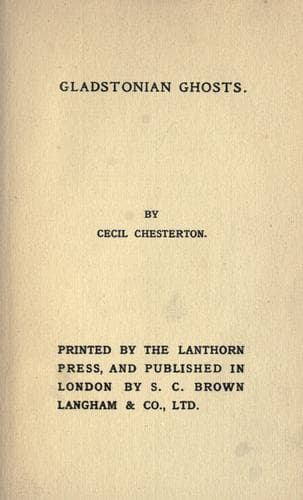
English essays -- 20th century; Great Britain -- Politics and government -- 1901-1910
I am aware that there has been of late in Socialist circles something
of a reaction against this sort of thing, as also against the futile
Marxian prophecies to the effect that “economic forces” would produce
a “Crisis” which would have the effect of abolishing the capitalist
system whether anyone wanted it abolished or no. But the reaction
has taken an entirely wrong turn. It has resulted so far in nothing
better than an outburst of sheer sentimentalism as unacceptable to
the hard conservative common-sense of the workers as the doctrinaire
revolutionism that preceded it. The chief expression of this
sentimentalism may be found in the repudiation of the Class War by
the leaders of the I.L.P. and the substitution of vague talk about
Universal Love and the Brotherhood of Man. Now here the I.L.P. leaders
have got hold of quite the wrong end of the stick. The existence of
the class war is a fact of common observation. A short walk down any
street with your eyes open will show it to you. Indeed it is obvious
that there is and must be a permanent antagonism between the buyers
and sellers of labour--or if our hyper-economic critics prefer it of
“labour-power.” And moreover this fact of the class war is a fact,
which every workman (as also every capitalist) recognises in practice,
if not in theory. All trade unionism is built upon his recognition of
it; so is the demand for a labour party. The error of the S.D.F. did
not lie here.
The Marxians were not wrong in saying that there was a class war;
there is a class war. They were not wrong in saying that the worker
ought to be educated in class-consciousness; they ought to be so
educated for their class-consciousness is the best foundation for our
propaganda. Where the Marxians were wrong in regard to the class war
was in their tacit assumption that “class-consciousness” was identical
with Socialism. It is not. Socialists and Trade Unionists are alike in
their _recognition_ of the class war, but they differ widely in their
attitude towards it. The Socialist wishes so to organise society as
to bring the Class War to an end; the Trade Unionist wants the war to
go on, but he wants his own class to get better chances in it than
they get at present. As regards practical matters the path of the two
is for the present largely identical. Extended factory legislation,
old age pensions, housing, the municipalisation of monopolies are
desired by Socialists and Trade Unionists alike, though not entirely
for the same reasons. Here and there, on Trade Union Law, on Compulsory
Arbitration in industrial disputes, in some instances on Child Labour,
the attitude of the two may appear different, but it only requires the
better economic education of the unions to bring them into line with
the Socialists on these points. Nevertheless, the distinction as well
as the relation between the two must be kept constantly in mind, if
the attitude of the typical manual worker towards Socialism is to be
understood.
Public-domain text, read in full here on John Shaqi.
Reviews
Reviews
No reviews yet
Be the first to share your thoughts on this work.
Elsewhere in the archive
Join the Discussion
Join the discussion
Sign in to leave a comment or review.
Sign InorCreate an account