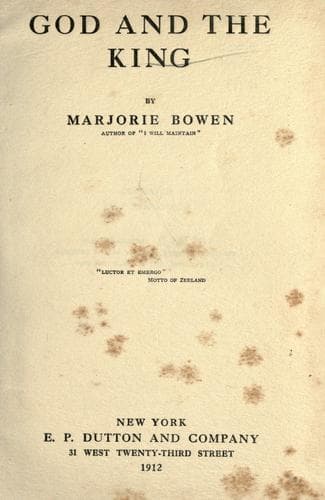
Great Britain -- History -- Revolution of 1688 -- Fiction; James II, King of England, 1633-1701 -- Fiction
His bright glance went from face to face. He came slowly to the head of
the table, and seated himself in the wand-bottomed chair there; his
ministers were on their feet waiting for him to speak. Surprised as
they were by this unexpected appearance, their agitation showed in their
faces, Shrewsbury in particular was colourless; only Lord Godolphin
remained perfectly composed.
The King continued to look from one to the other; he wore a heavy brown
velvet thickly braided with gold, and held in his right hand a paper
written upon, and folded across.
"Affairs," he said, in his tired voice, with his peculiar short manner
of speaking, "have reached a crisis, my lords, and I have come to
acquaint you with my resolution."
He leant forward a little, and rested his right arm on the table,
keeping his dark, powerful eyes fixed on these ministers whom he read so
perfectly.
"My lords," he continued quietly, almost gently, "it is a year since I
took up the government of this country, and in that time I have done
nothing to please any one of you." He coughed and pressed his
handkerchief to his lips. "I have done my best to govern justly," he
added proudly, "but I confess I took up a task beyond my powers. My
lords, I cannot rule a disaffected country with disaffected ministers.
I admit I do not understand you. As I am often reminded, I am a
foreigner."
The five nobles made a common movement as of painful expectation. The
King’s plain speaking took all words from them; Shrewsbury was painfully
agitated.
"What doth Your Majesty propose?" asked Halifax anxiously.
The King opened out the paper on the dark walnut table, and laid his
right hand on it. He wore round this wrist a bracelet of red glass or
crystal, cut into facets, that caught and threw back the light; it
gleamed now strongly through the thick Bruges lace of his ruffles.
"I mean," he said, "to resign the crown and return to Holland—where I am
needed," he added strongly.
"My God!" exclaimed Caermarthen; the rest were silent.
The King surveyed their changed and utterly amazed faces with a gleam in
his eyes.
"My convoy is in readiness," he said, "and here, my lords, is the speech
in which I announce my intention to Parliament"—he glanced at Sidney
Godolphin—"my lord," he added with dignity, "will do me a last service
and correct my poor English——"
Caermarthen broke out passionately—
"Sir, you cannot know what you are saying—this is unheard of——"
"I know very well what I am saying, my Lord Marquess," answered William.
"I cannot please you, but I think the Queen can. I believe you would be
faithful to her—she is English; but as for me, you can manage your
business better without me—and I am needed on the Continent."
He rose, and Halifax, rather pale, came up to him.
"What is to become of England if Your Majesty leaveth us?"
"The Queen will please you," repeated William.
"This action on the part of Your Majesty will mean chaos," cried
Shrewsbury desperately.
Public-domain text, read in full here on John Shaqi.
Reviews
Reviews
No reviews yet
Be the first to share your thoughts on this work.
Elsewhere in the archive
Join the Discussion
Join the discussion
Sign in to leave a comment or review.
Sign InorCreate an account