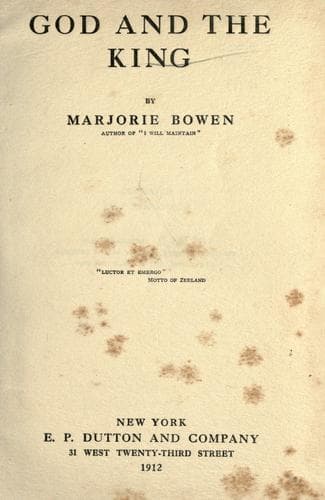
Great Britain -- History -- Revolution of 1688 -- Fiction; James II, King of England, 1633-1701 -- Fiction
Mary, a woman and utterly unused to business (though she had always
taken an intelligent interest in politics), yet found all these men, on
whose wisdom she was supposed to rely, peevish and silly. Marlborough
was using her sister to stir up opposition against the Government,—she
strongly suspected him, Godolphin, and Russell of having made their
peace with King James; Caermarthen she personally disliked; the Crone
and Fuller plot had proved to be a widespreading affair, in which there
appeared every possibility of her uncles being involved; the country was
denuded of troops, and the fleet in disorder; the treasury empty, and
the French threatening the Channel.
These were the first few moments of leisure the Queen had known since
her husband’s departure; she was eager to have Hampton Court ready for
his return, and so had come eagerly to see the progress of the
rebuilding and alterations.
Here again she was met with difficulties and humiliations. Sir
Christopher Wren, the architect, was in want of money, the workmen were
unpaid, the contractors refused to deliver any more Portland stone on
credit.
Mary had no money, and knew not where to get it; she soothed Sir
Christopher as best she could, and desperately resolved that these debts
should be paid; the thought of them was an added vexation. She felt
there was a kind of meanness in so lacking money, and that the
rebuilding of Hampton Court, which had been her one pleasure, was a
reproach and a mistake.
M. de Ginckle had written to her from Ireland that they were so
straitened in the camp that the King had refused to sign for wine for
his own table, and was drinking water with the men.
Mary thought of this passionately as she surveyed the unfinished
building the grumblers declared such an unwarranted luxury, and
remembered the noble fortune William had lavished on the public cause.
Under some pretence, she slipped away from her ladies and Sir
Christopher, and, with a wild longing to be alone, made her way to some
of the old deserted Tudor rooms of the palace, opened now for the first
time for perhaps fifty years.
In the wing in which Mary found herself there were near a hundred
chambers, and she, new to the palace, was soon lost in the maze of
apartments.
She was wildly glad to be alone, to drop, for a moment, the mask of
composed gaiety that she ever kept over her anxiety.
Door after door she opened, and room after room she traversed, until she
reached a little winding stairway that led to a chamber in one of the
fine red turrets with the graceful decorated chimney-stacks that Sir
Christopher was so calmly destroying.
Stairway and chamber were both covered with thick white dust; the bolts
on the door were rusty and loose; there was no furniture save an old
rotting chest, rudely carved; but the walls were beautifully panelled
with oak in a linen pattern, and the low lancet window disclosed a
perfect view.
Public-domain text, read in full here on John Shaqi.
Reviews
Reviews
No reviews yet
Be the first to share your thoughts on this work.
Elsewhere in the archive
Join the Discussion
Join the discussion
Sign in to leave a comment or review.
Sign InorCreate an account