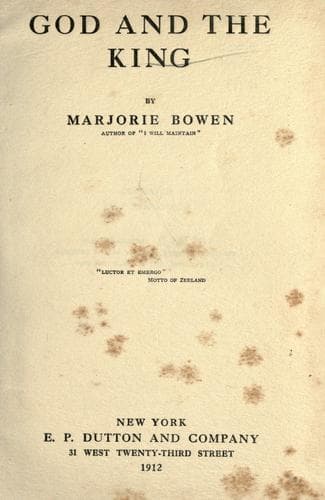
Great Britain -- History -- Revolution of 1688 -- Fiction; James II, King of England, 1633-1701 -- Fiction
"Your father can take you out."
"Father is working with Master Wren. Do you know Master Wren?"
"Yes."
"He goeth up and down in a basket outside the house. Once I went too,
and he held me so tight that it hurt. He is too old to play with."
He came a little farther into the room, eying Mary wistfully. She was
stately as well as tall, and the high lace commode she wore, and the
stiff arrangement of her heavy curls, further added to her dignity. The
child looked at her in some awe.
"Are you cross with me?" he asked gravely.
"No," answered the Queen—"no—but your father will be looking for
you—best go and find him."
"I have lost my way," he said, subdued by her coldness. "I was asleep in
there." He pointed to the little sunny annexe to the turret from which
he had come. "I am glad I met you, ma’am."
"Why?" asked Mary.
The child smiled, in an effort to win her.
"I get frightened when I am alone," he said. "Don’t you, ma’am?"
"Sometimes," answered the Queen; she bit her lip and fixed her narrowed
brown eyes on the boy; he was fair, and rather delicate, and wore a
shabby suit of red tabinet.
He slowly and reluctantly moved towards the narrow dark stairs.
"I wish this house was finished," he said plaintively. "It is so large.
The King will live here," he added. "I saw the King talking once to Mr.
Wren."
Mary gave him no encouragement to stay, but he still lingered by the
rotting door, that swung back against the wall, and looked at her with
wide, puzzled eyes.
"I am going now," he said at last; his hands went to his cravat, which
was sadly knotted. "Would you tie this for me first? Father don’t like
me to look untidy."
"Come here," said Mary.
He came at once and stood before her.
"I don’t think I can do it," said the Queen unsteadily.
She took hold of the scrap of cambric awkwardly, while he obediently
held his head up; but her cold fingers bungled, and the bow was clumsy.
"I can’t do it," she murmured.
"You are so tall, ma’am!"
She looked into his upturned face.
"Too tall to be so stupid," she answered, and untied the bow. "Have you
a mother?" she asked suddenly, holding his shoulder gently.
"No, ma’am."
"Ah, poor soul!"
She spoke so sadly that he was distressed.
"What is the matter, ma’am?"
"I was thinking of what we both have missed," said Mary gently.
His bright eyes were bewildered. The Queen drew him to the old chest,
seated herself there, and again tied the cravat.
"What is your name?" she asked, as she smoothed it.
"James, ma’am—it was the King his name when I was born," he added
proudly.
Mary drew a quick breath.
"But you serve King William."
"I know," he answered dutifully. "He is a soldier, father saith. I
would like to be a soldier, ma’am."
Mary smiled; though she had done with his cravat she still kept her
hands lightly on his shoulder.
"Not a wood-carver?"
He shook his head.
"Father saith, ’Better be a soldier these days—there is no living
else,’" he quoted wisely.
Public-domain text, read in full here on John Shaqi.
Reviews
Reviews
No reviews yet
Be the first to share your thoughts on this work.
Elsewhere in the archive
Join the Discussion
Join the discussion
Sign in to leave a comment or review.
Sign InorCreate an account