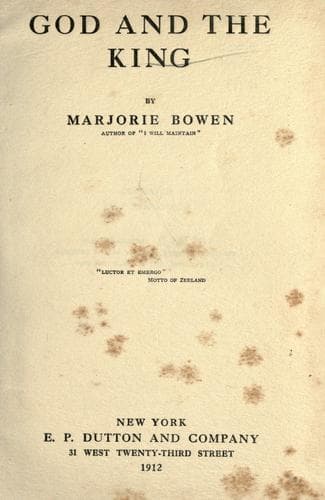
Great Britain -- History -- Revolution of 1688 -- Fiction; James II, King of England, 1633-1701 -- Fiction
Facing her, Sir John Lowther, commonplace, courtly, agitated, was
stabbing the polished table with a broken quill; to his left sat Edward
Russell, impatient, blond, swaggering; to his right, Pembroke, gentle,
hesitating, reserved. Godolphin, thin and hectic, was, as ever, mute
and self-effacing; his companion was the restless, feverish, and
volatile Monmouth, extravagantly dressed and fiery in manner.
Opposite him sat the gloomy honourable Nottingham, and another man, an
object of peculiar dislike and suspicion both to the King and Queen,
John Churchill, recently created Earl of Marlborough.
Of all the company he was the most remarkable in appearance—young, tall,
of extreme good looks, though florid and flamboyant in type, of a calm,
easy, and courtly demeanour, but obviously not an aristocrat nor
anything of a great gentleman, but rather of a kind of vulgarity, even
in his richly coloured beauty, and in that different to the other
ministers, who were all of noble appearance; he was dressed in scarlet
silk and wore a very rich sword-belt; he sat opposite the window, and
the sunlight made his splendour glitter.
My Lord Devonshire was of another and more winning type of handsomeness;
his young face was refined and delicate in feature, yet expressed an
ardent strength and a proud decision; he looked continually at the
Queen, and seemed, with the exception of Caermarthen, to be the only one
who had much sympathy or regard for her position.
"The conspirators——" began Nottingham heavily. He was drawing up a list
of the suspected names; he had industrious spies, as the Whigs had found
to their cost.
"Well, my lord?" asked Godolphin imperturbable. He had made his peace
with King James himself, but was calm in the knowledge that he had been
far too cunning to leave evidence of it in anybody’s hands.
Nottingham pursed his lips; he added a name to his list, and handed the
paper with a significant look to Russell, who shrugged and passed it on
to Monmouth.
"These are people to be put under arrest, are they not?" asked that
nobleman.
"Yes," said Nottingham dryly. "Shall I leave that last name?"
The paper was now in Lord Marlborough’s hands; he smiled serenely, and
put up his glass.
Mary spoke, and her woman’s voice sounded strangely in the council
chamber.
"What is this name?"
Marlborough inclined with great deference towards her.
"The Earl of Clarendon, Your Majesty."
The other councillors were silent; he was the Queen’s uncle, and even
the most callous of them felt some pity for her dilemma. Devonshire cast
an indignant look on Marlborough, whom he hated, but nothing could put
that gentleman out of countenance.
"I will erase the name," muttered Nottingham.
The Queen put out her hand in a gesture to stay him.
"No, my lord. I know," she said, with great dignity, "and you all know,
that my Lord Clarendon is far too guilty to be left out."
"A wise decision, Your Majesty," remarked Marlborough calmly.
Public-domain text, read in full here on John Shaqi.
Reviews
Reviews
No reviews yet
Be the first to share your thoughts on this work.
Elsewhere in the archive
Join the Discussion
Join the discussion
Sign in to leave a comment or review.
Sign InorCreate an account