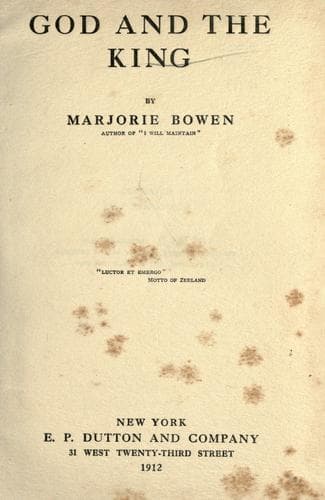
Great Britain -- History -- Revolution of 1688 -- Fiction; James II, King of England, 1633-1701 -- Fiction
"Have you ever had the smallpox?" she asked gently.
They both answered together.
"Yes, Your Majesty; but not the black smallpox, an it please Your
Majesty."
Mary looked into their fair, undisfigured faces.
"No," she answered; "the black smallpox is ever fatal, is it not——"
"They say so, Your Majesty," said the elder girl, pinning up the lace on
the silver underskirt. "And there is a deal of it in London now, Your
Majesty."
Mary made no reply. They finished with the dress and left her, having
laced her into the brown velvet.
The Queen put out the silver lamp and went into the antechamber where
the ladies were chattering over the tea Lady Temple was making in a
Burmese silver urn.
Mary seated herself near the fire.
"We will go to Kensington House to-morrow," she said. Then, noticing
Lady Temple’s look of surprise, she added, with a slight tremor in her
voice, "I have a fancy to be near the King."
CHAPTER VIII
FEAR
My Lord Sunderland was climbing from obscurity, disgrace, and infamy to
that great position he had once held—climbing very cautiously, working
secretly, biding his time, venturing a little here, a little there,
helped always by my lady and some few ancient friends.
The King had been obliged to leave him out of the Act of Grace. He was,
nevertheless, at this moment waiting for a private audience of His
Majesty, who had already visited him in his princely palace at Althorp.
The King had gone in state to Parliament; my lord did not care to yet
take his seat in the House on great occasions; he preferred to wait in
Whitehall and reflect quietly on his policies.
He believed that the summit of his ambitions was about to be reached; he
had staked on William of Orange twenty years ago, and had never lost
faith in him. The King was not a man to be ungrateful. Sunderland saw
close within his grasp the moment he had worked for steadily,
unscrupulously, so long—the moment when William of Orange and he should
rule England together.
From his seclusion at Althorp he had watched the King’s stormy reign,
and known that if he had been at William’s right hand half the troubles
would have been averted or smoothed over.
He was even scheming to make the Court popular; the attitude of the
people towards his hero considerably annoyed him.
Public-domain text, read in full here on John Shaqi.
Reviews
Reviews
No reviews yet
Be the first to share your thoughts on this work.
Elsewhere in the archive
Join the Discussion
Join the discussion
Sign in to leave a comment or review.
Sign InorCreate an account