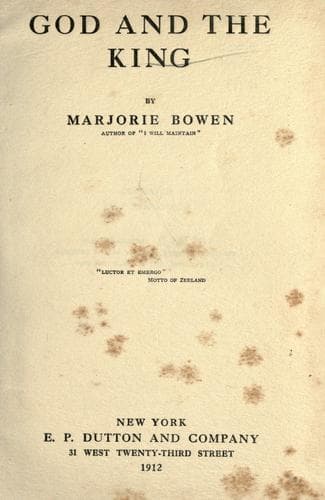
Great Britain -- History -- Revolution of 1688 -- Fiction; James II, King of England, 1633-1701 -- Fiction
At first a kind of wild joy had possessed her that she would go first;
but the agony of leaving him alone was almost as awful as the agony of
being left.
Because she could not endure to face his anguish she had so far
concealed from him both her certainty of her own approaching end and her
own belief as to her malady. Dr. Radcliffe alone among the physicians
had said smallpox, and been laughed at for his opinion, but the Queen
knew that he was right. "Malignant black smallpox," he had said, and she
knew he was right in that also.
Few recovered from this plague; few lived beyond the week.
Alone in the little cabinet, consecrated by so many prayers,
meditations, and tears, the young Queen faced her fate.
"I am going to die," she said to herself. "I am going to die in a few
days."
She sat back in her chair and caught her breath. The stillness seemed
to ache in her ears. So little done, so much unfinished, so many
storms, troubles, attempts, poor desperate endeavours, and now—the end.
She recalled that when the King had been last on the Continent she had
been ill of a sore throat, and been so melancholy on account of the
dismal state of public affairs, the ingratitude and malice of the
people, that she had wished to die, but checked that thought, believing
that she could still be of service to her husband. And now it was no
wish or idle fancy, but the very thing itself.
And she must leave him.
Her deep piety made her think the agony she endured at that thought a
punishment for having so deeply loved a human creature. She tried to
fix her mind on God, but earthly affection was stronger. The image of
heaven became dim beside the image of him to whom her whole heart had
been given; the very tenderness that had been provoked in him by her
illness made it harder.
At last she rose and went over to a little gilt escritoire in the
corner; there were locked away all the letters she had ever had from the
King, some from her father, a Prayer Book of her mother’s before her
conversion, some of her own meditations and prayers, her diary, and
various little trifles with poignant associations.
With the keys in her hand she hesitated, but courage failed her to open
any of the drawers; she returned to the large bureau and took up a sheet
of paper.
She felt ill and cold; her limbs were heavy, her eyes ached, and her
head was full of pain. She made a strong effort of will to take up the
quill and write; at first the pen shook so there were mere ink-marks on
the paper.
What she wrote were a few last requests to the King: that her jewels and
clothes might be given to her sister Anne, that her servants might be
looked after, that he would remember his promise with regard to the
hospital at Greenwich, and that if Leeds was disgraced the King would
deal mildly with him—"for he hath ever been a good servant to us."
Public-domain text, read in full here on John Shaqi.
Reviews
Reviews
No reviews yet
Be the first to share your thoughts on this work.
Elsewhere in the archive
Join the Discussion
Join the discussion
Sign in to leave a comment or review.
Sign InorCreate an account