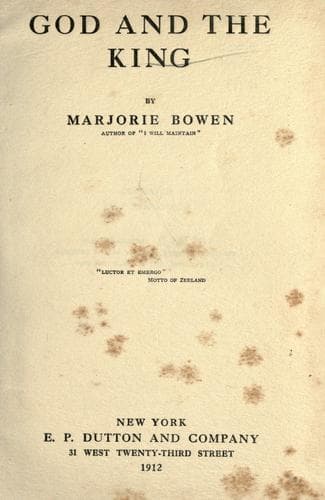
Great Britain -- History -- Revolution of 1688 -- Fiction; James II, King of England, 1633-1701 -- Fiction
Portland did not reply. He bitterly resented that this man, whom he
scorned and despised, should gain this intimacy with the King’s
weakness; but he led the way to William’s apartments. He had practically
control of affairs since the King’s collapse, and no one questioned his
coming or going.
They found William in his cabinet that overlooked the privy gardens, at
the bottom of which the river rolled black and dismal in contrast to the
glitter of the snow on the paths and flowerbeds.
The King sat by the window, gazing out on this prospect, his head sunk
on his breast and his left arm along the sill of the window. The
crimson cut crystal bracelet round his wrist was the only light or
colour on his person, for he wore no sword, and his heavy black clothes
were unbraided and plain; the considerable change in his appearance was
largely heightened by this complete mourning, for he had seldom before
worn black, having, indeed, a curious distaste to it. He had been born
in a room hung with funeral trappings and lit only with candles, and for
the first months of his life never left this black chamber, which had
caused, perhaps, a certain revulsion in him to the sables of mourning,
which he had worn only once before, when, a pale child of ten, he had
been dressed in black for his young mother, that other Mary Stewart
whose coffin lay in Westminster within a few feet of that of his wife.
He did not seem to notice that any had entered upon his privacy.
Portland glanced back at Romney and the Lord Keeper with a look that
seemed to convey that he felt hopeless of my Lord Sunderland doing what
he had boasted; but that lord went forward with his usual quiet
carriage.
A large fire filled the room with cheerful light that glowed on the
polished Dutch pottery and rich Dutch pictures on the mantelshelf and
walls. On a marquetry bureau, with glittering brass fuchsia-shaped
handles, was a pile of unopened letters, and amid them a blue-glazed
earthenware dragon that used to stand in the Queen’s withdrawing-room at
Hampton Court.
Sunderland paused, looking at the King. The three other men remained
inside the door, watching with painful attention.
"Sire," said the Earl, "there is news from France. M. de Luxembourg,
who was your greatest enemy, is dead."
The King did not move.
"It is a great loss to King Louis," added Sunderland. "They say M. de
Villeroy is to have the command."
William slowly turned his head and looked at the speaker, but without
interest or animation, almost, it seemed, without recognition.
Sunderland came nearer. A book was lying on the window-seat, he glanced
at it—it was Dr. Tenison’s sermon on the text, "I have sworn and am
steadfastly purposed to keep thy righteous judgments," which had been
preached after the Queen’s death, and printed by the King’s command.
Sunderland spoke again.
"The Whigs have ousted my Lord Leeds and his friend Trevor—and continue
to press heavily upon him."
Public-domain text, read in full here on John Shaqi.
Reviews
Reviews
No reviews yet
Be the first to share your thoughts on this work.
Elsewhere in the archive
Join the Discussion
Join the discussion
Sign in to leave a comment or review.
Sign InorCreate an account