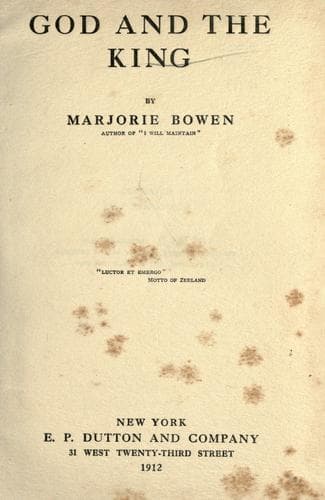
Great Britain -- History -- Revolution of 1688 -- Fiction; James II, King of England, 1633-1701 -- Fiction
The sentence remained unfinished, for a French cannon shot laid M.
Godfrey dead at the King’s side. William had hoped that this would
prove a lesson to useless meddlers, but even since he had been provoked
by various people who had business at the camp, and who strayed into the
trenches to get a view of real fighting, often with no conception of the
danger of the slow dropping bombs and bullets.
But this afternoon the King’s eagle eyes were satisfied that the works
were clear of sightseers; it had been fairly well spread abroad that
this assault would be, beyond experience, terrible, and those whose duty
did not take them to the front were well in the rear.
M. de Hesse and the other Germans having galloped off to their posts,
the King remained alone with his staff, midway between the ramparts that
were to be attacked and the English trenches, full in the cross-line of
fire, and motionless and conspicuous as a target on the little jutting
shelf of rock; his officers were a little way behind, and his figure was
completely outlined against the blue gap of sun-filled air behind the
rock slope.
He rode a huge grey Flemish horse, dark as basalt and as smooth—very
lightly trapped with red leather linked with silver gilt—that he managed
as well as a man can. He had always been renowned for his consummate
horsemanship, and this great beast, that had taken two footmen to hold
in before he mounted, he held delicately with one hand on the reins with
such a perfect control, that the creature was utterly motionless on the
narrow ledge of slippery rock.
The hot air was full of different distant and subdued sounds—the rattle
of the guns, the clink of the matchlocks striking the cobbles of the
town below, the tramp of feet, the neighing of horses, and,
occasionally, the crowing of a cock on some farm outside Namur.
The King sat with his reins loose, holding in his right hand his baton
that he rested against his hip. He was intently watching the English
trenches.
The clocks of the churches in Namur struck one; instantly a loud report
and a jet of flame came from the trenches below; two barrels of
gunpowder had been blown up as a signal for the attack.
Before the smoke had cleared, all the minor sounds were silenced by the
steady beat of drums and kettledrums, and the King perceived the
Grenadiers marching from behind their defences and earthworks steadily
towards the ramparts of Namur—these were the men of Cutt’s own regiment.
They were immediately followed by the four new battalions. They came on
steadily, in good order, with their bright, unspoilt colours in their
midst, their colonels riding before them. The King could discern the
slender figure of John Cutts marching on foot before the Grenadiers with
his drawn sword in his hand.
Public-domain text, read in full here on John Shaqi.
Reviews
Reviews
No reviews yet
Be the first to share your thoughts on this work.
Elsewhere in the archive
Join the Discussion
Join the discussion
Sign in to leave a comment or review.
Sign InorCreate an account