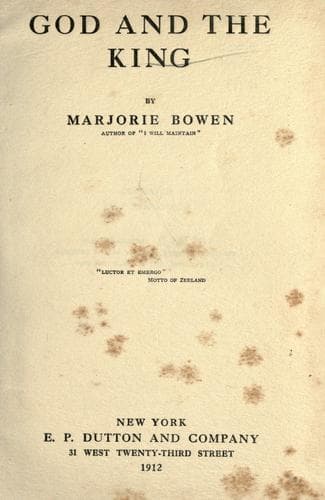
Great Britain -- History -- Revolution of 1688 -- Fiction; James II, King of England, 1633-1701 -- Fiction
He had been a little confused, but in no way appeased by her
conversation. She had confessed that she and Sunderland were behind van
Keppel, towards whom his thoughts turned with added dislike; then he
tried to banish consideration of all three of them, and to fix his mind
on the money he must obtain for the King.
Devonshire (the Lord Steward), Pembroke (Keeper of the Privy Seal), and
Dorset (the Lord Chamberlain), were talking apart, and Portland joined
them.
Pembroke informed him that Montague had gone down to the General Meeting
of the Bank of England and had promised to return immediately with the
news of the result of the Directors’ proposition to the Company.
"If these hopes vanish," said Devonshire gloomily, "what are we to turn
to next?"
"A Parliament and taxes," answered Dorset concisely.
"Oh, my lord," cried Pembroke, "Mr. Locke will tell you that is bad
finance."
"Mr. Locke is a philosopher," remarked Dorset good-humouredly.
"Good God, we get choked with ’em," remarked the magnificent Devonshire.
"Now Montague hath brought Mr. Newton into the Mint and Somers is always
deep with Mr. Locke——"
"And my Lord Portland," cried Dorset, with the irrepressible levity of
his class and nation, "deep with a poet for his secretary."
"As for that same poet," said Portland gravely, "I tell you, my lord,
that he now goeth to Church, and will not write profane verses on a
Sabbath."
"A triumph indeed for the godliness of your lordship," said Devonshire
demurely.
"Is this poor Matt Prior?" asked Dorset. "His verses on the taking of
Namur were very neat."
"I did not read them," answered Portland dryly. "I never could endure
poetry or play-acting—the King is plagued with enough to paper London."
"I remember in The Hague," smiled Devonshire, "when His Majesty was
expecting a promise of money from Amsterdam by every post, and I took in
a letter which I thought was it—but which proved to be a copy of verses
on his safe crossing from England, with a fresh heathen god in every
line—His Majesty’s curses were powerful for a Christian Prince—and he
declared it had given him a distaste for the very sight of poetry."
Dorset laughed; he remembered the occasion also as the only one on which
he had heard violent language from the austere King. Portland was
disgusted that they could amuse themselves with these recollections
during such anxious moments; it was only another proof, he thought, of
the shallowness of the English politicians. And even these anecdotes
turned on the King’s lack of money; it must be six years since
Devonshire was at The Hague, and William was still in the same straits.
Portland wondered if the time would ever come when he would be free of
these burdens, and doubted it.
The Chancellor of the Exchequer entered the gallery, and instantly
everybody formed a little group about him, including the two ladies, to
whom he gave a flourishing and gallant greeting.
Public-domain text, read in full here on John Shaqi.
Reviews
Reviews
No reviews yet
Be the first to share your thoughts on this work.
Elsewhere in the archive
Join the Discussion
Join the discussion
Sign in to leave a comment or review.
Sign InorCreate an account