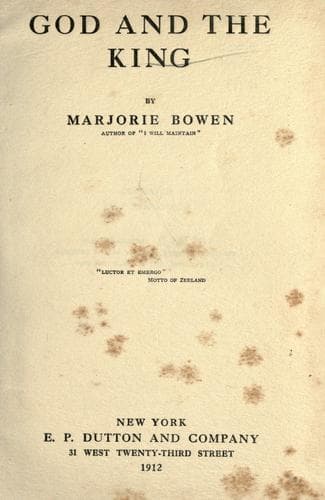
Great Britain -- History -- Revolution of 1688 -- Fiction; James II, King of England, 1633-1701 -- Fiction
"I think," replied the young Chancellor, "without vanity, that the Bank
of England is an institution that will live."
CHAPTER VIII
THE BREAKING FRIENDSHIP
Two men were riding side by side through the forest of Soignies; before
and behind them was a great army. It was a May night, with the moon
full overhead and casting long shadows from the tall, dark, motionless
trees. News had been received at the camp the evening before that the
French were threatening Brussels, and the confederate army was marching
to save the Capital.
These two men who rode in the centre were alone, though part of such an
immense force; for the Dutch guards, who marched before and behind them
were several yards distant; they were both wrapped in long military
cloaks. One, who was the King-Stadtholder, the commander of the allies,
was mounted on a white horse; the other, William Bentinck, Earl of
Portland, rode a great brown steed. The King was speaking very
earnestly, in a lowered voice suited to the hush of the warm night and
the solemnity of the long denies they traversed.
"I must tell you of the dispatch I received from my Lord Devonshire. I
had scarcely received it before we broke camp, or I had told you before.
This John Fenwick, the Jacobite, hath made a cunning confession,
designed to put the Government into a confusion. He accuseth Godolphin,
Shrewsbury, Marlborough, and Russell of being deep with St. Germains."
Portland made no answer.
"It was," continued the King, "no news to me, as you know."
"What have you done?" asked the Earl.
"I have done nothing yet. I shall write to Devonshire ordering the
trial of this Fenwick to proceed."
"And for these lords?"
"I shall affect to disbelieve this evidence," answered William. "And
Shrewsbury, at least, I shall assure of my trust."
"And so traitors flourish!"
There was silence for awhile, only broken by the jingle of the harness,
the fall of the horses’ feet, and the tramp of the army before and
behind. The faces of the two men were hidden from each other; they
could only discern outline of horse and figure as the moonlight fell
between the elms and oaks.
The King spoke again.
"I have learnt to be tolerant of treason. These men serve me—even
Marlborough—instruments all of them! And Shrewsbury I ever liked. I
will not have him put out for this."
"You will even let them remain in office?"
"Surely," answered the King, "it would be beneath me to stoop to
vengeance? And what else would this be? Both policy and kindness
dictate to me this course."
Portland’s voice came heavily out of the morning shadows.
"You are too lenient to every sort of fault. These men do not even know
you spare them—they think you are fooled. Marlborough will laugh at
you."
"What doth that matter if he serveth my turn? He is a villain, but a
great man—he should be useful to England."
Public-domain text, read in full here on John Shaqi.
Reviews
Reviews
No reviews yet
Be the first to share your thoughts on this work.
Elsewhere in the archive
Join the Discussion
Join the discussion
Sign in to leave a comment or review.
Sign InorCreate an account