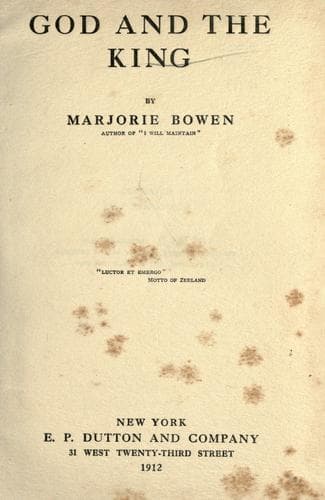
Great Britain -- History -- Revolution of 1688 -- Fiction; James II, King of England, 1633-1701 -- Fiction
It was early summer of the first year of the new century; there was
peace in Europe, prosperity in England and the United Provinces; the
work of William of Orange seemed finished indeed; he had dismissed the
Parliament that had so insulted and humiliated him without a word, and
as soon as it was up had gone into retirement at Loo; he had lost, it
seemed, all interest in England, and even in the affairs of Europe.
When the death of the infant Electoral Prince had reduced the first
Partition Treaty to wastepaper, William had framed another with the
Archduke Charles as claimant; the discovery of this had provoked great
wrath in England.
Portland, Somers, and Montague had been threatened with impeachment; M.
Canales, the Spanish Ambassador, had delivered an impertinent memorial
to William, who was now regarded as a powerless cipher in a
Parliament-ruled country, and the King had ordered him to be dismissed,
and recalled his ambassador from Madrid. As long as Louis kept to the
second Partition Treaty—and William could not doubt but that he would
keep so grave an undertaking—he cared nothing for what they did in
England; he left the government in the hands of a feeble Tory ministry,
of which the late Queen’s uncle, Lord Rochester, was the head, and,
heedless of the complaints and murmurs, remained in retirement at
Guelders.
Matthew Prior thought this a sorry end for his hero. This flinging of
everything to chance, this cynical indifference, this apathetic calm,
seemed a poor conclusion for all that high hope, that serene courage,
that long, splendid, patient endeavour, that continuous, glorious
action.
He thought sorrowfully that it was now too late. The King was no longer
a power in Europe he had been crossed and humbled before all the world,
his army had been taken from him, his private grants revoked, his public
policy abused, his friends, his ministers, attacked, that Spanish
government that in the days of his greatness had humbly offered him the
Spanish Netherlands, now dared to insult him; and he was a dying man.
Matthew Prior sighed gloomily as he walked through the formal grounds
with their exact parterres, flower-beds, groves, and alleys, their twin
fountains and regular groups of trees.
The King had been at dinner when he arrived, and he was waiting his
audience with some sinking of the heart; he had not seen William since
the peace was proclaimed, three years ago.
It was about three of the clock when he was sent for, and conducted into
the large dining-room where the King was still at table.
The Palace, which was one of the most admired in Europe, had been built
by William with lavish magnificence on the site of his favourite
hunting-box. Mr. Prior, who had seen Versailles, was impressed by the
commodious nobility of the apartments through which he passed.
Public-domain text, read in full here on John Shaqi.
Reviews
Reviews
No reviews yet
Be the first to share your thoughts on this work.
Elsewhere in the archive
Join the Discussion
Join the discussion
Sign in to leave a comment or review.
Sign InorCreate an account