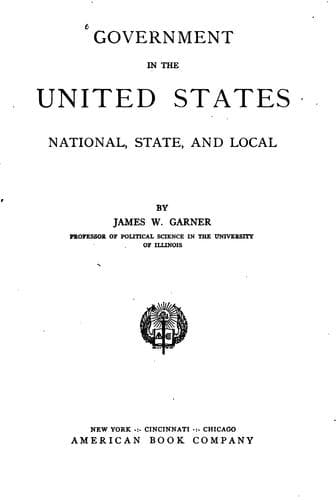
Government in the United States, National, State and LocalGarner, James Wilford
History
Government in the United States, National, State and Local
Garner, James Wilford
United States -- Politics and government
_The Laws Now in Force_ prescribe that all railway rates and charges for
carrying freight and passengers must be just and reasonable; that no
rebates, drawbacks, or special rates shall be granted to particular
shippers; that no discriminations shall be made as to rates or service
to certain persons or places; that no free passes, with certain
specified exceptions, shall be granted; that no greater charges shall be
made for a "short haul" than for a "long haul"; that no railroads shall
be allowed to transport commodities which they are engaged in producing,
with certain exceptions; that competing railways shall not be allowed to
pool their freight or earnings; that schedules showing rates, fares, and
charges shall be published and kept open for inspection and cannot be
changed except after thirty days' notice to the commission; that all
railroads shall keep their accounts according to a uniform system
prescribed by the commission; and that they shall make annually to the
commission a full and complete report of their business and earnings.
An important extension of the interstate commerce act was made in 1906,
when express and sleeping car companies, pipe lines used for
transporting oil from one state to another, and telegraph, telephone,
and cable companies engaged in sending messages from one state to
another or to foreign countries, were brought under the operation of the
law and their business subjected to the same conditions and restrictions
as those applying to railroads. By an act of 1912 railroads were
prohibited from owning, controlling, or having any interest in competing
water carriers, and by an act of 1913 provision was made for preparing a
valuation of all railroads in the United States.
Congress has also enacted laws requiring interstate railroads to equip
their cars with automatic couplers and other safety appliances, fixing
the liability of railway employers for injuries sustained by railway
employees, encouraging the arbitration of railway strikes, and
establishing an eight-hour work day on railways (1916). An act excluding
the products of child labor from interstate commerce (1916) was declared
unconstitutional by the Supreme Court.
In pursuance of acts of Congress passed in 1916 and 1918, the President
in 1918 took over the control of railroads, telegraphs, and telephones
for the duration of the war.
Public-domain text, read in full here on John Shaqi.
Reviews
Reviews
No reviews yet
Be the first to share your thoughts on this work.
Elsewhere in the archive
Join the Discussion
Join the discussion
Sign in to leave a comment or review.
Sign InorCreate an account