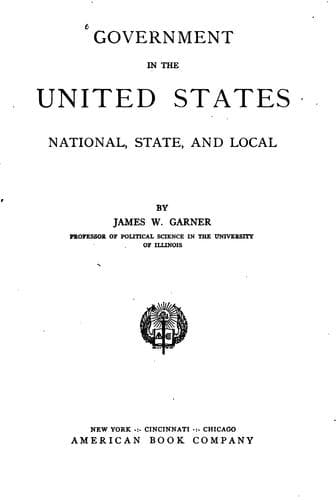
Government in the United States, National, State and LocalGarner, James Wilford
History
Government in the United States, National, State and Local
Garner, James Wilford
United States -- Politics and government
_Activity of the Presidential Candidate._--Formerly it was not
considered proper for the presidential candidates themselves to take an
active part in the campaign by traveling about the country and making
speeches, but in recent years there has been a change in this respect.
Mr. Bryan in 1896 traveled about the country and delivered hundreds of
speeches in behalf of his candidacy, and he pursued a similar course in
1900 and again in 1908 when he was the Democratic candidate. In the
latter year, Mr. Taft, the Republican candidate, likewise entered
actively into the campaign and delivered more than 400 speeches in
thirty different states. In 1912 Mr. Wilson and Mr. Roosevelt made
extensive campaign tours and delivered many speeches. Similar tours were
made in later campaigns.
=Raising and Expenditure of Campaign Funds.=--The management of a
national political campaign requires the expenditure of large sums of
money for printing, postage, telegrams, express, rent of halls, music,
expenses of speakers, organizing clubs, and the like. This money is
spent solely under the direction of the national chairman, who until
recently was not required to render an account of the moneys contributed
for this purpose.
_The Raising of Campaign Funds._--Prior to 1884 the expenditures on
account of a national campaign were comparatively small and were raised
by the party in power largely by assessments on federal office-holders;
but the civil service law enacted in the year previous forbade
assessments of this kind and thus cut off an important source of supply.
More attention then began to be turned toward the great corporations,
many of which desired to become the beneficiaries of special legislation
or to secure immunity from government interference with the management
of their business. In a recent campaign, one corporation, a life
insurance company, contributed $200,000; one railroad company gave
$100,000; and many others $50,000. Sometimes a corporation contributes
equally to the campaign funds of both parties, on the principle that it
is a wise policy to be on good terms with each.
Public-domain text, read in full here on John Shaqi.
Reviews
Reviews
No reviews yet
Be the first to share your thoughts on this work.
Elsewhere in the archive
Join the Discussion
Join the discussion
Sign in to leave a comment or review.
Sign InorCreate an account