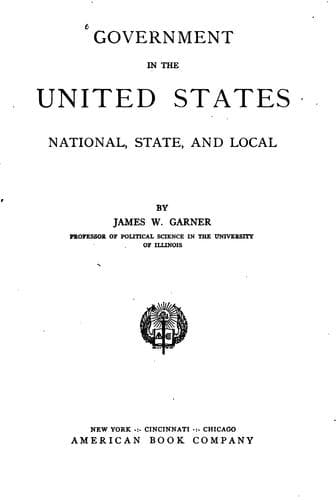
Government in the United States, National, State and LocalGarner, James Wilford
History
Government in the United States, National, State and Local
Garner, James Wilford
United States -- Politics and government
Before the Civil War, large quantities were given to the states for the
construction of canals and railroads. Large tracts of the public lands
have also been granted to private corporations as subsidies for the
building of transcontinental railways. Finally, by an act of 1902, the
proceeds from the sale of all public lands in seventeen Western states
are set aside for constructing irrigation works in those states.
By the _preëmption act_ of 1841, it was provided that 160 acres of land
should be given to any family living thereon for a period of six months
and paying $200 therefor. This act was repealed in 1891, but millions of
acres were disposed of during the fifty years it was in force.
By the _homestead act_ of 1863, still in force, any head of a family may
acquire 160 acres by living on it for three years (it was five years
before 1912), cultivating a certain part of it, and paying a small fee.
_The Public Lands now Remaining_ aggregate about 665,000,000 acres,
including those in Alaska. Of these lands a large part have been set
aside for Indian reservations, national parks, military reservations,
and national forests,[92] and is therefore not open to purchase or entry
under the homestead act. Arid lands are sold in tracts not exceeding 640
acres at $1.25 per acre; mineral lands are sold at from $2.50 to $5 per
acre; timber and stone lands at a minimum of $2.50 per acre; town site
lands at a minimum of $10 per acre; and agricultural lands at $1.25 per
acre.
[92] There are now 153 national forests, embracing 175,940,000 acres.
_Land Offices_ are established in all the states where there is any
considerable amount of public land left. At each office there is a
register and a receiver who examines applications for entries and issues
certificates upon which patents or deeds are finally granted.
=Indian Affairs.=--Another important branch of the government service
falling within the department of the interior is the management of
Indian affairs. For a long time each tribe was treated to some extent as
though it were an independent community, and was dealt with somewhat as
foreign nations are dealt with. In 1871, however, it was enacted that
henceforth no Indian tribe should be acknowledged or treated as an
independent nation or power with which the United States may contract by
treaty--an act which marks the beginning of the end of Indian tribal
authority.
The policy of extending the jurisdiction of the government over the
Indians was begun by an act of 1885 which gave the United States courts
jurisdiction over seven leading crimes when committed by Indians on
their reservations. Previous to that time, crimes committed by Indians
against Indians within a reservation were left to be dealt with by the
tribal authorities themselves.
Public-domain text, read in full here on John Shaqi.
Reviews
Reviews
No reviews yet
Be the first to share your thoughts on this work.
Elsewhere in the archive
Join the Discussion
Join the discussion
Sign in to leave a comment or review.
Sign InorCreate an account