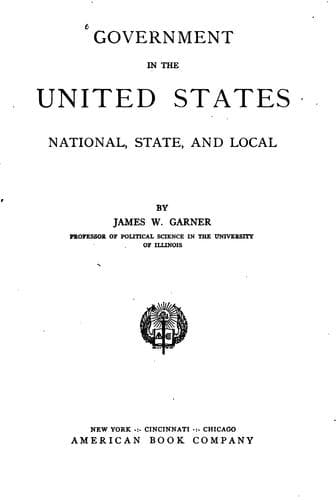
Government in the United States, National, State and LocalGarner, James Wilford
History
Government in the United States, National, State and Local
Garner, James Wilford
United States -- Politics and government
"corrupted" or "attainted," so that as a matter of course, without any
decree of the court to that effect, his children could not inherit
property or titles through him. Thus the innocent offspring of the
traitor were punished for the offense of the parent. The provision of
our Constitution places the punishment on the offender alone.
=References.=--ANDREWS, Manual of the Constitution, pp. 201-223.
BALDWIN, The American Judiciary, ch. ix. BEARD, American Government
and Politics, ch. xv. BRYCE, The American Commonwealth (abridged
edition), chs. xxi-xxii. HARRISON, This Country of Ours, chs.
xx-xxi. HART, Actual Government, ch. xvii.
=Documentary and Illustrative Material.=--1. The Congressional
Directory, which contains a list of the higher judges and the
judicial districts. 2. Specimen copies of decisions of the Supreme
Court. These may be obtained from the clerk of the Supreme Court at
Washington.
RESEARCH QUESTIONS
1. Name the Chief Justices of the United States Supreme Court from 1789
to the present time.
2. Name the present members of the Supreme Court and give the date of
the appointment of each. (See Congressional Directory).
3. In which one of the nine judicial circuits of the United States do
you live? Who is the Supreme Court justice assigned to the circuit? Who
are the circuit judges of the circuit?
4. Who is the United States district judge for your district? At what
places in your state are United States district courts held?
5. Who is the United States attorney for your district? The United
States marshal?
6. What is meant by the terms "constitutional" and "unconstitutional" as
applied to an act of Congress? Do you think the courts should be allowed
to declare a law unconstitutional?
7. Do you think it is a wise provision which allows federal judges to
serve during good behavior?
8. It has been proposed by a well-known public man that federal judges
should be elected by the people. What is your opinion of the
proposition?
9. Do you think the present salary allowed justices of the Supreme Court
large enough to attract the best judicial talent?
10. Do you think the Supreme Court is ever justified in reversing its
own decisions, or should it stand by the precedents?
11. What is the meaning of the term obiter dicta as applied to a
judicial opinion?
12. Do you think it is a wise practice for judges who disagree with the
majority of the court to file dissenting opinions?
13. A recent President took occasion to criticize publicly a federal
judge for a decision which he rendered in a "trust" case. Do you think
judges should be criticized for their decisions?
14. Are juries ever made use of in federal courts? If so, when?
15. Why have federal judges been criticized for issuing injunctions?
16. When may an appeal be taken from a state court to a federal court?
Public-domain text, read in full here on John Shaqi.
Reviews
Reviews
No reviews yet
Be the first to share your thoughts on this work.
Elsewhere in the archive
Join the Discussion
Join the discussion
Sign in to leave a comment or review.
Sign InorCreate an account