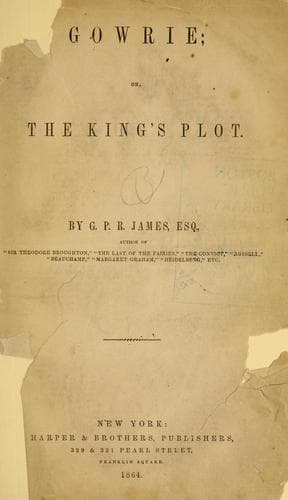
Gowrie; or, the King's Plot.James, G. P. R. (George Payne Rainsford)
General
Gowrie; or, the King's Plot.
James, G. P. R. (George Payne Rainsford)
Gowrie Conspiracy, 1600 -- Fiction
We can hardly bring our minds in the present day to believe that all
this ceremonious respect, this ostentatious display of reverence for a
fellow man, could have any effect upon the view which reasonable
beings would take of a simple question of justice. But there was very
little of the old Roman left in the sixteenth century. When men sold
their loyalty and compounded for their treason, it was not to be
supposed that justice was unmarketable. Cromwell, with all his faults
and all his crimes, was the first who thoroughly purified the seat of
justice, and taught the world that, in one country at least, neither
rank nor wealth, nor even long conceded privilege, could prove a
shield against the sword of justice. The immunities claimed by and
granted to ambassadors were then enormous, and the influence of high
rank often amounted to elevation above the law. The officer of the
guard, though a man sensible of his duties and willing to perform
them, was not less subject than others to the general feelings of the
age and country in which he lived; and Monsieur de Malzais, though
resolute even to obstinacy and bold to rashness, was habitually
impressed with the reverence thus thought due to high station; and
though they had both entered the room with a determination to require
that Austin Jute should be at once given up to justice, the honours
shown to his master by the ambassador of the haughtiest queen in
Europe, rendered their demand very moderate in tone, and not very
persevering in character.
To the surprise of both, however, Gowrie himself pressed for immediate
investigation. He had been brought up in a sterner school, in which
that spirit prevailed which afterwards shone forth with so strong a
light in the higher and purer of the puritan party in England.
"I do not request your excellency," he said, after the officer of the
guard had stated his object, and Monsieur de Malzais had preferred his
charge, "to throw your protection over my servant, unless a clear case
of justification can be made out in his favour; and then only so far
as to shield him from long imprisonment and perhaps suffering, till it
is ascertained whether the gentleman he has wounded lives or dies. I
doubt not that the laws of the land will do justice between man and
man, though the one be a mere servant and the other a person moving in
a more elevated station of life, and I shall myself stay to see that
it is so. But, in the first instance, as your own countryman and as my
servant, I think you have every right to inquire whether he did, as he
says, injure this gentleman in his own defence or not."
Public-domain text, read in full here on John Shaqi.
Reviews
Reviews
No reviews yet
Be the first to share your thoughts on this work.
Elsewhere in the archive
Join the Discussion
Join the discussion
Sign in to leave a comment or review.
Sign InorCreate an account