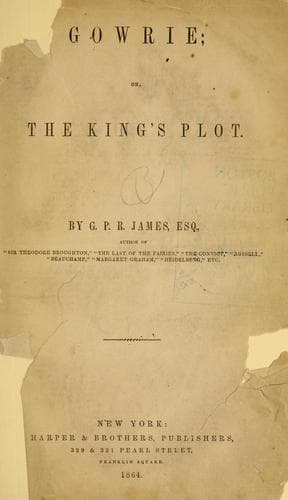
Gowrie; or, the King's Plot.James, G. P. R. (George Payne Rainsford)
General
Gowrie; or, the King's Plot.
James, G. P. R. (George Payne Rainsford)
Gowrie Conspiracy, 1600 -- Fiction
With all his fellow-servants, too, he was a very great favourite, for
he had not the slightest inclination to domineer, to exact, or to
exclude; and the curious sort of miscellaneous education which he had
received, or rather, which he had bestowed upon himself, gave him a
superiority that they were quite willing to acknowledge. He could
write, and he could read, which was more than many persons in a much
higher station could do at that time. He could play upon the fiddle
and the flute, and the hurdy-gurdy. He could carve all sorts of things
in wood. He had as many curious receipts as are to be found in the
"True Gentlewoman's Delight." He could catch all sorts of birds and
beasts by strange devices of his own. He could fence, use the sword
and buckler, or play at single stick like a master of the art of
defence. He could ride well, and was never known to appear either
tired or sleepy.
He had not been a couple of hours in Sir Henry Neville's house, before
a multitude of his small talents displayed themselves for the benefit
of the ambassador's servants; and his frank good humour soon gained
him plenty of friends in the household. Unlike most Englishmen, who
seem to look upon every man as an enemy till he has proved himself
otherwise, Austin Jute appeared to regard the whole human race as a
friend, which is, perhaps, the greatest of all secrets for smoothing
the way of life; and on the evening of the day of his arrival, he sat
in the hall at the embassy, carving a little sort of box or casket out
of a piece of yew, in which he produced the most extraordinary
devices, whistling all the time airs so wild and merry, that many of
the servants collected around to listen, and others looked over his
shoulder, examining the progress of his work.
While thus employed, one of the attendants came into the hall, saying,
"The news isn't good, Master Jute. The people say he will not get over
the night."
"Well, he knows best what he's about," answered Austin Jute, quietly.
"Every man must die once; and but once can a man die. He has got what
he deserved from me, and nothing more. He must manage the rest as he
likes himself."
"But it may be awkward for you, if he does die," answered the man.
"Not a whit," replied Austin Jute. "My luck is not at so low an ebb.
Fortune comes tripping, they say; and a stumble's no great matter so
there be not a fall. I say devoutly, 'God save the worthy gentleman!'
But if he dies, he dies; and it is no fault of mine--I wish him well."
"But who is the lady who was in the carriage?" asked another of the
servants; for curiosity, the passion of all semi-civilized people, was
even stronger then in capitals than it is now in country towns. "They
say she is not your lord's wife."
"No," answered Austin Jute, "but she is his cousin, which is better,
as the world goes. She will be his wife hereafter, if Heaven so will
it, and she live long enough to reach the first stage of woman's
decline."
Public-domain text, read in full here on John Shaqi.
Reviews
Reviews
No reviews yet
Be the first to share your thoughts on this work.
Elsewhere in the archive
Join the Discussion
Join the discussion
Sign in to leave a comment or review.
Sign InorCreate an account