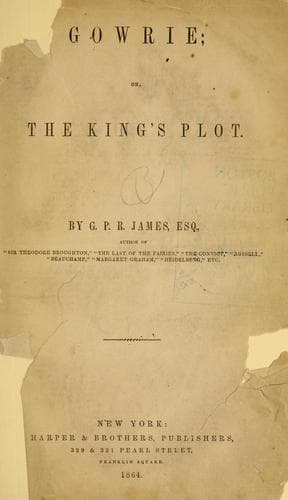
Gowrie; or, the King's Plot.James, G. P. R. (George Payne Rainsford)
General
Gowrie; or, the King's Plot.
James, G. P. R. (George Payne Rainsford)
Gowrie Conspiracy, 1600 -- Fiction
"I trust it is so," replied Neville; "but yet there remains a great
deal to be beaten out of him. The truth is, my dear lord," he
continued, with a laugh, "that the message first came to me, and
though, perhaps, kindly intended towards your servant, was still
somewhat insolent in its tone. He sent to say that he was recovering,
and that the man who had wounded him need fear no chastisement--that
was the word he used; and he then went on to say, that the man might
come to him in safety, when he would assure him of his pardon. We
rough islanders, my lord, are accustomed to think that no pardon is
necessary where no offence has been committed; and therefore I judge
that you had better not let your man go. It might only lead to evil
consequences; for I do not think, from Master Austin's look and
manner, that he is one to submit to haughty or injurious words without
a rejoinder."
"He certainly shall not go," answered Gowrie, "since such was the
message. However, I shall myself soon quit Paris, and therefore, Sir
Henry, if you will favour me with the letters which you have promised
me for the English court, I will deliver them with pride and pleasure,
as it is, of course, my intention to present my humble duty to her
Majesty Queen Elizabeth, as I pass through London."
"You shall have them this very evening," answered Neville; "but yet I
wish you would stay for a couple of days longer; for I know that you
are a great lover of music, and there is a very delicate concert to be
given the day after to-morrow. There are three of the most excellent
performers on the violin that ever were heard, besides some famous
singers from Italy; and they will perform several rare and beautiful
pieces by a new composer of great genius."
Lord Gowrie promised at once to stay for the high treat offered to
him; but he took his leave without informing Sir Henry Neville that he
had other objects in delaying his departure. Had the message of Ramsay
been that which he had imagined when he visited the ambassador, the
young earl would have quitted Paris on the following day; but the tone
in which he now found it was conceived, induced him to adopt another
course, and proceeding at once to his own chamber without seeing
Julia, he sat down and wrote the following note:--
"To Master Ramsay of Newburn, greeting:--
"Sir,
Public-domain text, read in full here on John Shaqi.
Reviews
Reviews
No reviews yet
Be the first to share your thoughts on this work.
Elsewhere in the archive
Join the Discussion
Join the discussion
Sign in to leave a comment or review.
Sign InorCreate an account