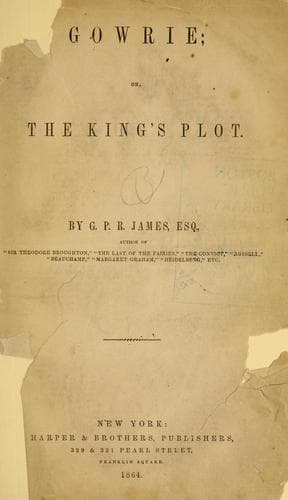
Gowrie; or, the King's Plot.James, G. P. R. (George Payne Rainsford)
General
Gowrie; or, the King's Plot.
James, G. P. R. (George Payne Rainsford)
Gowrie Conspiracy, 1600 -- Fiction
His companion, who had already seen the middle age, laughed gaily; for
I know neither age nor circumstance in which vanity will not do its
work. He seemed perfectly deceived, however, and indeed was so,
concluding that Gowrie, from some cause, suspecting the king's
purpose, had left his fair companion on the other side of the border.
He was not well satisfied, indeed, with the result of his mission, for
he had calculated upon gaining considerable credit with the king by
skilfully executing a somewhat delicate task. Their meal passed over
gaily, however; and Lindores, who was somewhat of a bon vivant, had
taken care that the table should be supplied with better wine than
could be procured at Langholm. Of this he partook abundantly, and
hospitably pressed his guest to do the same; but Gowrie was upon his
guard, and contrived to avoid the glass, without his companion
noticing that such was the case. In the meantime, Lindores, imagining
that each large double bottle was shared equally between him and the
earl, drank more than his due proportion, and passed through most of
the stages of inebriety, from loquacity to drowsiness. In the former
stage, however, the wine being in and the wit out, he laughed joyously
at the thought of the king's disappointment, and told his companion,
as a profound secret, the end and object of his journey to the border.
On the following day early, the earl and Lord Lindores set out
together for Edinburgh; but Gowrie thought fit to stop for the night
at Selkirk, while his companion pushed on somewhat farther, in order
to bear to the king the news of his disappointment in person. He
arrived in the capital at a somewhat early hour the next day, and
proceeded at once to the palace, where James's ill-humour knew no
bounds.
"That is just like those Ruthvens," he said, in the presence of Sir
Hugh Herries and John Ramsay, who were in the king's closet when
Lindores told his story. "They are all as wise as serpents, but not as
innocent as doves; and this lad is at the head of them. If he were not
at heart a rebel to his own liege sovereign, wherefore should he leave
the lass in England? Does it not give our good aunt Elizabeth a hold
upon him, which no foreign sovereign should have over one of our
subjects? Can she not twist him thereby what way she likes? Maybe his
treason is already consummate, and he has left the girl behind him as
a pignus or pledge for his carrying it out to our destruction. We must
deal softly with him, nevertheless," he continued, seeing that his
words had sunk deeply into the minds of those around him, and having,
perhaps, the example of Henry II. before his eyes--"we must deal
softly with him, till we find occasion against him; mind that, lads,
and let not one of ye cross him, so as to make the matter into a
private quarrel. He has many friends and great wealth, so we must go
gently to work with him till the time comes."
Public-domain text, read in full here on John Shaqi.
Reviews
Reviews
No reviews yet
Be the first to share your thoughts on this work.
Elsewhere in the archive
Join the Discussion
Join the discussion
Sign in to leave a comment or review.
Sign InorCreate an account