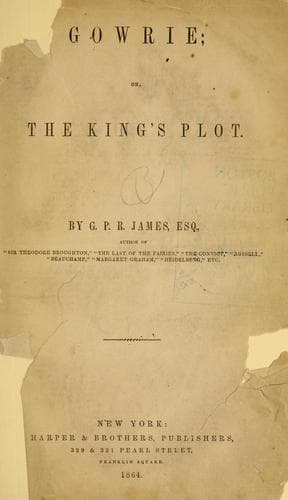
Gowrie; or, the King's Plot.James, G. P. R. (George Payne Rainsford)
General
Gowrie; or, the King's Plot.
James, G. P. R. (George Payne Rainsford)
Gowrie Conspiracy, 1600 -- Fiction
The spirit of his race now rose in his bosom. He saw before him,
invited apparently to meet him there that morning, the man who, when
his father, after an imperious order from the king to quit the realm
within fourteen days, lingered for a few hours longer at Dundee to
settle the affairs of his family, and to hire a ship to carry him
abroad, pursued him to the very port where he was about to embark, and
brought his head to the block. His patience could not endure any more,
and drawing back a step, he said, "I think, your majesty, it may be
better for me now to retire."
"Come, come, my Lord Gowrie," said the king, "I will not have you look
down upon Colonel Stuart. He is a worthy gentleman, and has done this
crown good service. Neither will I have you seek quarrel with him in
regard to passages long gone."
"Sir," answered the earl, with a low bow, "I will never seek that man,
but it is not fit that he should cross my path. As to seeking quarrel
with him, _aquila non capit muscat_. I now beseech your majesty to
pardon me for retiring;" and he withdrew slowly from the royal
presence.
CHAPTER XXVII.
The whole court of Holyrood was now busied principally with one
subject. It is the vice of all petty courts to have their whole
attention taken up with personal quarrels and small passions, not the
less venomous for their minuteness. The Earl of Gowrie was not a
favourite--that had become evident within one week after his return
from the continent; and although he neither held nor coveted any place
about the king's person, all those who were mounting the frail ladder
of courtly favour marked the coldness between the king and himself
with satisfaction, and augured the fall of those members of his family
who had obtained appointments in the royal household. At all events,
as far as he was personally concerned, Gowrie prepared to cut the
matter very short, by taking leave of the king within ten days after
his arrival in Edinburgh, upon the plea of visiting his mother, and
examining the condition of his own estates. Still he himself, and his
relations with the court, continued to occupy the thoughts of men.
From his wealth, from his connexions, and from his extensive property,
he was much too important a person to have his movements, his
demeanour, or his intentions considered lightly; and, far superior to
most of his fellow peers, both in acquired knowledge and intellectual
scope, he had shown so decided a leaning to that rational freedom
which was repugnant to all James's ideas of authority, that courtiers
readily learned to hate him because their royal master showed that he
feared him. Nevertheless, with the great majority of his equals in
rank he was very popular, and by the poorer classes he was universally
and dangerously beloved. The people cheered him when he appeared in
public, even while the courtiers were drawing back from his brother
and sister, in terror of the plague-spot of disfavour. Yet the effect
Public-domain text, read in full here on John Shaqi.
Reviews
Reviews
No reviews yet
Be the first to share your thoughts on this work.
Elsewhere in the archive
Join the Discussion
Join the discussion
Sign in to leave a comment or review.
Sign InorCreate an account