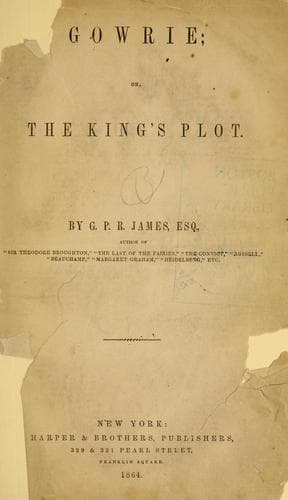
Gowrie; or, the King's Plot.James, G. P. R. (George Payne Rainsford)
General
Gowrie; or, the King's Plot.
James, G. P. R. (George Payne Rainsford)
Gowrie Conspiracy, 1600 -- Fiction
In the beautiful town of St. Johnstone, of Perth, on the west bank of
the river Tay, and in a line with the streets called Spey-street and
Water-street, the former of which, I believe, now bears the name of
South-street, stood, at the time I speak of, one of the largest and
most magnificent houses in Scotland, which well deserved the name of
The Palace which it sometimes obtained. It was generally called,
however, Gowrie House, or Gowrie Place, and occasionally, by the Earls
of Gowrie themselves, was termed "The Great House," to distinguish it,
probably, from their other mansions, of which they possessed several.
The extent of this building may be conceived, when we recollect that
the great court in the centre of the building was an oblong of sixty
feet in one direction, and ninety in the other. Round this immense
area rose four massive piles of building, raised at various epochs,
and of very different styles of architecture, but united into one
grand and imposing mass of masonry of a quadrangular form, and having
but one break, in the centre of the west front, where stood a large
and handsome gate of hammered iron, the view from which extended down
the whole line of the South-street. The gardens, which were very
extensive, and kept with remarkable care, lay at the back and to the
south, stretching in that direction to the town wall. At the
south-eastern angle of the garden rose a curious and very ancient tower,
called the Monk's Tower, from some tradition which has not reached me.
The parts of the building towards the Tay, and those towards the
south, were of an unknown antiquity, with walls of immense thickness;
and legends were current, even at the time of which I speak, of
persons having been confined by former lords, in secret recesses
within those heavy walls, and left to perish miserably. The northern
and western sides of the quadrangle were far more modern, and had
probably been erected either by the Countess of Huntley, who once
possessed the palace, or by some of the early Lords of Ruthven. By
whomsoever they were built, much pains had been employed to remodel
the internal arrangements of the older building, so as to make it
harmonize, within at least, with newer parts; and each successive Earl
of Gowrie had expended large sums in improving the accommodation which
the great house afforded, so as to meet the advance of his country in
luxury and refinement. Nor was decoration wanting; for in the south
range a number of small chambers had been swept away to form a
gallery, which was one of the finest at the time in Europe; and it had
been the pride of William, the first earl, to collect from all
countries, for this large chamber, pictures by the greatest artists of
the day.
Public-domain text, read in full here on John Shaqi.
Reviews
Reviews
No reviews yet
Be the first to share your thoughts on this work.
Elsewhere in the archive
Join the Discussion
Join the discussion
Sign in to leave a comment or review.
Sign InorCreate an account