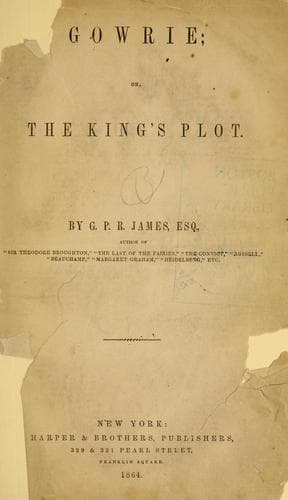
Gowrie; or, the King's Plot.James, G. P. R. (George Payne Rainsford)
General
Gowrie; or, the King's Plot.
James, G. P. R. (George Payne Rainsford)
Gowrie Conspiracy, 1600 -- Fiction
It was a gay sight in the town of Edinburgh, as, on the morning of the
twenty-third of March, all the principal nobles of the land rode,
gallantly attended, to the council for which the king's summons had
gone forth, and many were the persons assembled to see them pass. No
great joy or satisfaction, however, shone upon the countenances of the
good citizens of Edinburgh, for the rumour already had spread through
the city that a new tax was in contemplation to support the
extravagance of the king, and to enrich the minions of the court.
Never was a greater mistake made than that which is attributed to
David Rizzio, who is said to have expressed an opinion, when warned by
Sir James Melville of the peril which menaced him, that the bark of
the Scotch people was worse than their bite. On the contrary, history
proves that the bite, and that a sharp one, came frequently before the
bark. On the present occasion, there were no loud expressions of
popular feeling, except perhaps, when one of those barons in whom the
people had confidence happened to pass; but a dull and menacing sort
of gloom hung over the crowd, and whatever they thought, it was
expressed in low tones to each other. Gowrie was one of the first on
the way, and a shout greeted him when he approached the crowd
assembled near the palace gates, for there the council was held; but
the noise soon died away, and he was riding on, when a half-witted man
ran out from amongst the rest, and laid his hand upon the earl's rein,
saying, "Don't you vote for the tax, Gowrie! Don't you vote for the
oppression of the people. We poor folk can hardly bear it."
Gowrie said some kind but unmeaning words to the poor man, and passed
quietly on his way, arriving at the gates a few minutes before the
appointed hour. At the door he was met by the king's porter, who
informed him that his majesty had not yet left his apartments; and
with a slow step and very thoughtful countenance, the young earl was
walking across to the foot of the staircase, when young John Ramsay
came hastily forward from the fireplace, by which he was standing, and
accosted him, saying, "My lord the earl, I wish to speak to you."
"Ah, Ramsay!" said Gowrie, turning round, and holding out his hand, "I
did not see you!"
The young man, however, drew a little back, and replied with a haughty
and somewhat overbearing air, "There are some matters to be settled
first, my lord, before I know whether we are friends or enemies."
"It may be just as you please, sir," answered Gowrie calmly, gazing at
him with some surprise; "what is the matter?"
"I understand, my lord," replied the young man, "that one of your
servants has murdered, in Perth, my brother's man, Walter Matthison--a
person whom I protected."
Public-domain text, read in full here on John Shaqi.
Reviews
Reviews
No reviews yet
Be the first to share your thoughts on this work.
Elsewhere in the archive
Join the Discussion
Join the discussion
Sign in to leave a comment or review.
Sign InorCreate an account