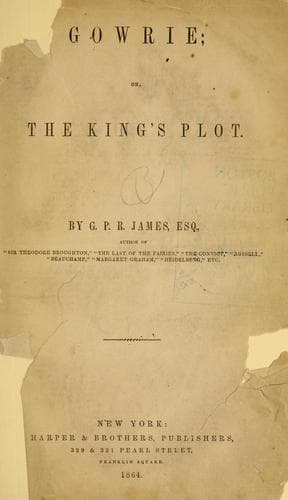
Gowrie; or, the King's Plot.James, G. P. R. (George Payne Rainsford)
General
Gowrie; or, the King's Plot.
James, G. P. R. (George Payne Rainsford)
Gowrie Conspiracy, 1600 -- Fiction
Another quarter of an hour passed, and various noblemen, who arrived
somewhat late, went up the stairs without Ramsay noticing them. At
length, one of them, who was acquainted with him, hurrying in,
remarked him standing by the fire, and said, "Ah, I am glad to see you
there, Ramsay. I was afraid the king would be gone in to the council,
for I was detained by----"
"So he is," answered Ramsay, abruptly; and the gentleman hurried up
the stairs without waiting to finish his sentence.
The young gentleman followed with a slow step; and when he entered the
council chamber, a scene presented itself which I must attempt to
depict. The king was seated in a large arm chair, or throne, a few
steps in advance of the private door through which Ramsay passed.
Before him stretched a long table, or council board, at which were
seated almost all the great nobles of the land. Behind the king's
chair, and nearly filling up the vacant space between it and the wall,
were a number of the gentlemen of the royal household. Amongst these
were Sir George Murray, Sir Hugh Herries, Sir Thomas Erskine, Mr.
Alexander Blair, David Moyses, and nearer to the door, Sir David
Murray of Cospetrie, afterwards created Lord Scoon, a man of more mind
and intelligence than James was usually inclined to tolerate.
It would appear that the tax which the king wished to inflict upon the
people had been proposed for the consideration of the lords; and that
the debate, if it may be so called, had proceeded some way, for it is
known that the first three or four who spoke briefly expressed their
approbation. At the moment when Ramsay entered, however, the Earl of
Gowrie was on his feet, in the act of addressing the council. But that
he had spoken for some minutes; and that the argumentative part of his
speech was over was evident, for the only words which Ramsay heard
were, "For these reasons, my lords: because the tax would be
burdensome in its nature; because it would be unequal in its pressure;
because the people in this realm have not the means of meeting so
large a claim upon their loyalty; and because the actual necessity of
so great a demand, either for the purpose of maintaining the king's
royal dignity, or for securing the peace and safety of the country,
has not been clearly shown to exist; I, for my part, would humbly
petition his majesty, according to his great wisdom, to devise some
other means more easy to his loyal subjects for meeting the
necessities of the time----and," he added, after a moment's pause, as
if hesitating whether to utter the words which rose to his lips, "and
in his gracious condescension, and in that love and affection which he
is known to bear to all his subjects, to confine his requirements to
the limit of their means, and the most pressing exigencies of the
state."
Public-domain text, read in full here on John Shaqi.
Reviews
Reviews
No reviews yet
Be the first to share your thoughts on this work.
Elsewhere in the archive
Join the Discussion
Join the discussion
Sign in to leave a comment or review.
Sign InorCreate an account