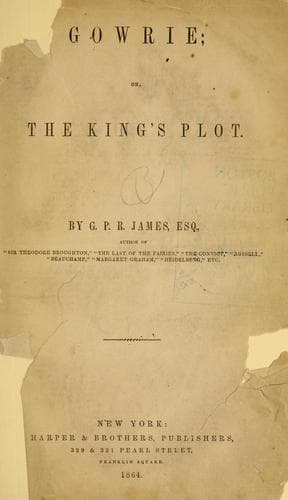
Gowrie; or, the King's Plot.James, G. P. R. (George Payne Rainsford)
General
Gowrie; or, the King's Plot.
James, G. P. R. (George Payne Rainsford)
Gowrie Conspiracy, 1600 -- Fiction
"I can assure your majesty that you are in error there," said Gowrie.
"Count Manucci lived in absolute poverty from the time he quitted
Scotland, having been expelled from Florence, as your majesty probably
knows, on account of his religious opinions. He received a small
pension from the Earl of Angus up to the day of his death, which the
earl would certainly not have paid if the count had obtained
possession of all his uncle's wealth."
"That looks like truth," cried James. "I should not wonder if Angus
had got the money himself."[3]
"Of that I know nought, sire," answered Gowrie; "but I can assure your
majesty that the only wealth this dear girl brings with her to me is
herself, and three thousand ducats which her grandfather had saved."
"Sorry to hear it," said the king. "We could have wished you a
wealthier bride, my lord;" and there he stopped.
Gowrie remained also silent, anxious to hear what the king's
consideration of the subject would lead him to, and at all events to
get some definite answer upon which he might act. He thought that the
next question might be, where he had left Julia, but he was prepared
with an answer even for that, although he much wished to avoid being
compelled to give it. James, however, notwithstanding his despotic
principles and his anxiety to establish a complete absolutism in
church and state, was constitutionally timid with those of whose
resistance he had had any experience; and he did not like to drive the
earl to refuse an answer. He therefore merely said that which
precluded him afterwards from acting upon the information he had
really obtained, giving the earl greatly the advantage.
"And so the lady is in Italy?" he observed, after a somewhat
lengthened pause.
"No, sire, she is not," answered Gowrie. "Her present abode I have
engaged to keep secret, till such time as I may be permitted to
present her to your majesty as my wife. Immediately that such is the
case, and that we can be married, I will go to seek her, with your
majesty's leave."
"As far as the court of London, I suppose?" said James, somewhat
bitterly.
"No, sir, not above one quarter as far," replied the earl. "I should
have been very sorry to have given any foreign prince a hold upon me,
even through my affections."
James remained silent, and seemed to hesitate, for he played with the
points of his doublet, and shuffled about the papers on the table.
"Well, my lord," he said at length, "the question is one of some
difficulty. We must consider of the subject fully. All those
Douglasses, even to the second degree, are banished men--exiled from
the land; and it cannot be decided just in a moment whether we shall
open the door to any of them. Besides, it might make strife and
contention. Here, you see, is a sort of claim set up to the lands of
Whiteburn, long since bestowed upon our faithful servant, Andrew
Stuart."
Public-domain text, read in full here on John Shaqi.
Reviews
Reviews
No reviews yet
Be the first to share your thoughts on this work.
Elsewhere in the archive
Join the Discussion
Join the discussion
Sign in to leave a comment or review.
Sign InorCreate an account