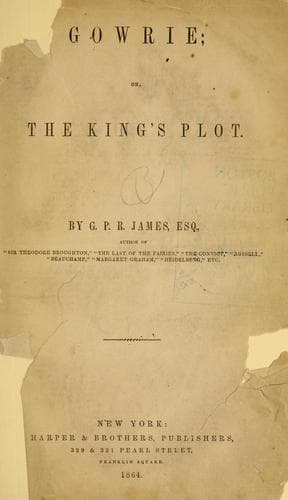
Gowrie; or, the King's Plot.James, G. P. R. (George Payne Rainsford)
General
Gowrie; or, the King's Plot.
James, G. P. R. (George Payne Rainsford)
Gowrie Conspiracy, 1600 -- Fiction
I need not pause to detail the passing of the day with Gowrie. The
law's delay is proverbial as one of the banes of human existence in
the blessed land wherein we live.--It was so even in his time; and he
found, on consulting with those who had to deal with such matters,
that the drawing up of the renunciation, simple as it seemed, would
require the labour and attention of several days, in order to couch it
in the full and ample terms which he knew would be required by the
king. He had to give long explanations, and to enter into details
which he had not previously considered, so that the greater part of a
spring day was consumed before he left the dim and dingy den where the
man of law held his abode. On his return to his own house he passed
more than an hour in walking up and down the large and handsome
sitting-room, and meditating over the past and the future. If it be
asked whether his thoughts were sad or bright, I must answer, very
much mixed, as is ever the case with a man of strong sense and active
imagination. But Gowrie, it must be remembered, was in the spring of
life, in that bright season when the song of the wild bird, hope, is
the most loud and sweet and seducing. The circumstances which
surrounded him might alarm or sadden him for the time, but the
cheering voice still spoke up in his heart, and the syren sang not in
vain. At length he ordered lights to be brought, and casting himself
into a chair, took up a book--his favourite Sallust--and began to
read. The pages opened at the Catiline, and the first words struck
him, as strangely applicable to the half-formed resolution which had
been floating vaguely in his mind, of passing life in peaceful
retirement.
"Omnis homines, qui sese student præstare ceteris animalibus, summa
ope niti decet vitam silentio ne transeant, veluti pecora, quæ natura
prona, atque ventri obedientia, finxit."
"And yet," he said, "methinks many a man can raise himself above
the brute without mingling in the busy turmoil of the world's
affairs--nay, do more real service to his country and his race in the
silence of deep but peaceful thought than in the noisy contests of
courts and cities."
Then he went on to read, till he came to the splendid description of
Catiline.--"Lucius Catilina, nobili genere natus, magna vi et animi et
corporis, sed ingenio malo provoque," &c.
Public-domain text, read in full here on John Shaqi.
Reviews
Reviews
No reviews yet
Be the first to share your thoughts on this work.
Elsewhere in the archive
Join the Discussion
Join the discussion
Sign in to leave a comment or review.
Sign InorCreate an account