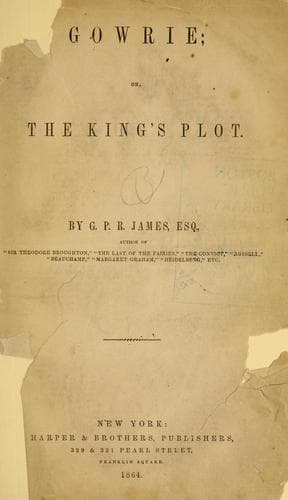
Gowrie; or, the King's Plot.James, G. P. R. (George Payne Rainsford)
General
Gowrie; or, the King's Plot.
James, G. P. R. (George Payne Rainsford)
Gowrie Conspiracy, 1600 -- Fiction
Perhaps what he said was true. We are all apt to forget the evils and
discomforts of a place we have left behind. Memory is fond of pleasant
objects, and plants thick ivy shrubs to rise up and decorate the ruins
of the past. He had forgotten the turbulence and dangers which had
surrounded his early days. He had almost brought himself to fancy
that, as compared with Italy, Scotland was a place of peace, and
security, and freedom, where the assassin's knife, the oppressor's
wrong, the tyrant's sway were comparatively unknown. But the bitter
reality was now before him; and he saw that to be an enemy of the
court was to be but a hunted beast, whom every dog of favour might
pull down and tear at liberty.
After a few minutes' thought, however, he cast off the impression, and
sent for the bailie, who was waiting to speak with him. This
magistrate was the reverse in everything of his junior, Bailie
Roy--tall, thin, and raw-boned in person, somewhat bluff, and very
laconic of speech; a man to be moved neither by fear or favour, but
strong in his attachments and steady in his sense of right. He made an
ungainly bow in answer to the earl's salutation, and at once dropped
into the seat which he was invited to take.
"I have come, my lord," he said, "about the prisoner, David Drummond."
And there he stopped, as if all his say was said.
"Well, Mr. Bailie, what of him?" rejoined the earl. "I hear he has not
been tried yet. If you will name the day most convenient to the
magistrates, I will come down for the purpose, and hold a court."
"They were thinking of the twenty-second of the month," answered
Bailie Graham; "aiblins that might not suit your lordship?"
"Quite well," answered Gowrie. "I will be down, undoubtedly."
Still Mr. Graham continued to sit and twirl his beaver, as if
labouring with some other question or announcement; and at length he
said, "Your lordship would not see the prisoner?"
"Certainly not," answered Gowrie. "He has been my own servant; and
even that might be supposed to have some effect upon my judgment; but
I can have no private communication with him while awaiting trial. If
he have anything to request, either to make imprisonment more
tolerable or to provide for his defence, let him demand it publicly."
"He said he would write to the king, my lord, when he was told of your
answer," replied the bailie; "and he did it."
"Can he write?" asked the earl, in some surprise.
"No, not just with his own hand," said Mr. Graham; "but he got a
scrivener to do it for him; and Bailie Roy, one way or another, got
goodman Jobson to tell him what it was he said."
"I do not wish to hear, Mr. Bailie," said the earl. "It was probably
intended for the king's ear alone."
"Ay, that it was," said the bailie, drily; "and no doubt his majesty
will think no more of it than it deserves. It's not like to do the
Earl of Gowrie much harm, I should think."
Public-domain text, read in full here on John Shaqi.
Reviews
Reviews
No reviews yet
Be the first to share your thoughts on this work.
Elsewhere in the archive
Join the Discussion
Join the discussion
Sign in to leave a comment or review.
Sign InorCreate an account