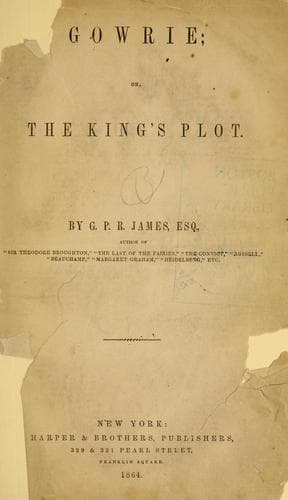
Gowrie; or, the King's Plot.James, G. P. R. (George Payne Rainsford)
General
Gowrie; or, the King's Plot.
James, G. P. R. (George Payne Rainsford)
Gowrie Conspiracy, 1600 -- Fiction
Thus saying, he led the way across the court towards the right hand,
and entering a door in a little projecting tower which stood in one
angle, he conducted his friend up a small staircase which was called
the Black Turnpike, being but scantily lighted by three small
loopholes. At the top of this staircase Gowrie opened a door which led
into a very large and handsome room, containing no furniture except
some tall straight-backed gilt chairs, covered with rich embroidered
velvet. Passing by another door on the right, the earl then took his
way across this spacious chamber to an entrance on the opposite side,
while Ramsay remarked, "This is the gallery-chamber, if I remember
rightly."
"Yes," replied the earl; "and that door behind us leads to my study,
which I have furnished well with books. I am afraid, however, that I
shall have to change my domicile, for the window looks down into the
street, and the noise often distracts my thoughts."
"You will soon have other books to read in your lady's eyes, my lord,"
replied Sir George Ramsay, with a smile; and passing on, they entered
by a small door that splendid gallery which formed the admiration of
all men who saw it in those times. The walls were hung with pictures
by the older masters of the Flemish, German, and Italian schools. Some
were of a very ancient date, almost contemporary with the revival of
the arts--more curious, perhaps, than beautiful, but yet not without
their beauty too. There were two or three Van Eycks, and one
especially, a fine picture of John of Bruges. But that which most
attracted the attention of Sir George Ramsay, even from the Titians
and the Correggios on the wall, were some large flat wooden cases,
placed upright around, and with the tops removed, showing the pictures
which the earl himself had collected in Italy. Amongst the rest was
one of very large size, on which the clear light from the north shone
strongly. It was rich and powerful in tone, and vigorous in
conception, representing Niobe weeping over her children amidst a
scene of great picturesque beauty, while the vengeful God of Day was
seen retiring in the distance with the work of death completed. Before
it Sir George Ramsay stopped for a moment or two, and gazed with
interest and admiration. When he turned round he found the young earl
standing beside him with his arms crossed upon his broad chest, and
his eyes fixed upon the female figure with a look of stern thought.
"What a beautiful picture!" exclaimed the knight; "yet it is by a hand
I do not know, and seems fresh from the easel. Who was the artist?"
"A young man of the name of Guido Reni," replied Gowrie. "It was
painted for me this last year in an incredibly short space of time,
for the artist wanted money; and I gave him his own price. But that
picture, Dalhousie, has a particular interest for me. Do you not think
the Niobe very like my mother?--younger a good deal, but still very
like."
Public-domain text, read in full here on John Shaqi.
Reviews
Reviews
No reviews yet
Be the first to share your thoughts on this work.
Elsewhere in the archive
Join the Discussion
Join the discussion
Sign in to leave a comment or review.
Sign InorCreate an account