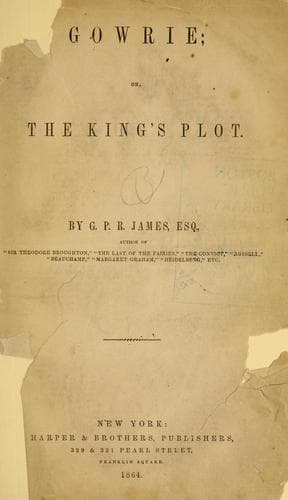
Gowrie; or, the King's Plot.James, G. P. R. (George Payne Rainsford)
General
Gowrie; or, the King's Plot.
James, G. P. R. (George Payne Rainsford)
Gowrie Conspiracy, 1600 -- Fiction
Erskine bowed, and stopped at the door; and James, with Alexander
Ruthven, passed through. In the large gallery chamber, standing in the
recesses of the window, were two or three men, dressed as the ordinary
household servants of the king--at least so says tradition. Alexander
Ruthven either did not see them, or took no notice of a circumstance
which had nothing extraordinary in it; but, advancing a step before
the monarch, he opened the door of his brother's cabinet, and James at
once passed in.
When the young man had his step upon the threshold to follow, however,
he paused for an instant and hesitated, seeing a tall dark man,
completely armed, already in possession of the room.
"Come in, Alex, bairn--come in," cried James, in a good-humoured tone.
The young gentleman, not without a feeling of dread, obeyed; and the
door was closed.
CHAPTER XLIII.
The court-yard of Gowrie palace--that large court-yard which I have
before described, of ninety feet in length by sixty in width--was
filled with men and horses from a little after one till a late hour in
the afternoon. Gowrie's own attendants had more than they could well
manage to do--the domestic servants in waiting upon the king and the
courtiers, and his grooms and stable-boys in taking care of the
horses. The granaries were thrown open. The servants of the strangers
helped themselves to what they needed; and men who had never been seen
in the place before, were running over the whole building. In vain Mr.
Cranston remonstrated, and endeavoured to preserve a little order; and
while he himself was obliged to be absent from the scene of confusion,
besought Donald Macduff, the earl's baron bailie of Strathbraan, who
had come down with his lord from Trochrie, to stop the people from
entering the palace and swilling the wine and ale at their discretion.
Christie, the porter, seemed to rejoice in the tumult, giving
admission to all who wanted it, to every part of the house, except the
two upper floors.
"There'll be nothing done," said Macduff, "unless one of them has his
head broke. It's all Christie's fault. He knows that he's to go
to-morrow, and cares not what he does. I'll split his weasand in a
minute with my whinger, if you'll but say I may, Mr. Cranston."
"No, no--no violence, Macduff," said Mr. Cranston; "especially not to
the king's people;" and he turned away into the house again.
Macduff stood sullenly on the steps of the hall, gazing with a bitter
heart on the scene before him, till Mr. Alexander Ruthven, of
Freeland, came up and spoke to him in a low tone, saying, "This is
really too bad, Macduff; some order ought to be taken with these
people."
"The king alone can do it, sir," replied the baron bailie; "and I
doubt that he chooses to do so, otherwise he would have taken better
care at first. I suppose he calls this spoiling the Egyptians."
"That scoundrel Christie has left all the doors open," said Mr.
Ruthven.
Public-domain text, read in full here on John Shaqi.
Reviews
Reviews
No reviews yet
Be the first to share your thoughts on this work.
Elsewhere in the archive
Join the Discussion
Join the discussion
Sign in to leave a comment or review.
Sign InorCreate an account