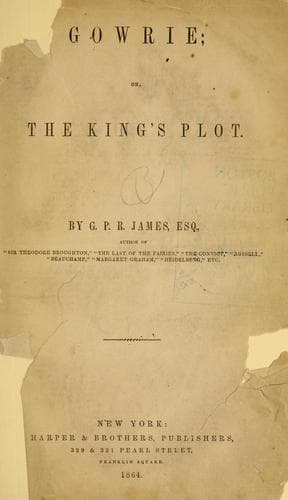
Gowrie; or, the King's Plot.James, G. P. R. (George Payne Rainsford)
General
Gowrie; or, the King's Plot.
James, G. P. R. (George Payne Rainsford)
Gowrie Conspiracy, 1600 -- Fiction
All was calm and still around them. Mr. Rhind sat reading a little
farther down the hill. A servant girl, who, with a sort of adventurous
spirit which often characterizes the peasantry of that part of the
country, had agreed to quit her home at Borgonovo, and accompany the
strangers into distant lands, was plying the busy needle within call.
The sleepy evening sunshine and the blue shadow crept in longer and
longer lines over the short turf and the scattered myrtle bushes, and
overhead, stretched out like a canopy, the broad dark branches of four
or five gigantic pines, while, at a little distance along the face of
the hill, was seen peeping out a Palladian villa, with large chesnut
trees, serving rather to break the hard straight lines than to conceal
that a house stood there. The villa indeed was uninhabited, for its
owner had retired into the city for the cooler and more rainy months
of winter; but still it gave to a scene unusually wild that air of
habitation and society which, under most circumstances, is pleasant
from the associations produced.
Their conversation was not gay, but it was cheerful--far more cheerful
than it had been since last they met; for memory of the dead had
darkened the horizon behind them, and frequent apprehension had spread
clouds over the prospect before. At several places where they had
stopped by the way, causes of alarm had occurred; and even at Piacenza
they had found reason to doubt their security. A man, who had known
Mr. Rhind in Padua, had met him in the streets, and told him a
distorted tale of poor Manucci's death and Julia's flight, declaring
boldly that the old man had been addicted to unlawful arts, and that
it was suspected his granddaughter had aided him in their pursuit. He
added, however--what neutralized in the mind of his hearer the effect
of his tale, as far as poor Julia was concerned--that she was clearly
guilty, because she had never been known to come to confession or seek
absolution of the priest. Now, however, both Gowrie and her he loved
felt in security, for he had taken measures to guard against surprise;
and the memory of the loss she had lately sustained had been somewhat
softened by time and the rapid passing of many stirring events. Gowrie
strove to cheer her, to remove apprehension, to efface the traces of
the first deep sorrow she had known; and though gaiety would have
jarred with her feelings, yet a cheerful tone mingled with deep
thought, will often find its way to a heart which would reject direct
consolation and fly from painful merriment.
On the preceding day she and Gowrie had read together the papers which
had been intrusted to him by Manucci, and the perusal had been sad;
for there she found the tale of all that her parents had suffered, and
though she could not but rejoice to feel that no disparity between her
own rank and that of her husband could make his friends look cold upon
her, yet the impression--at least the first impression--was
melancholy.
Public-domain text, read in full here on John Shaqi.
Reviews
Reviews
No reviews yet
Be the first to share your thoughts on this work.
Elsewhere in the archive
Join the Discussion
Join the discussion
Sign in to leave a comment or review.
Sign InorCreate an account