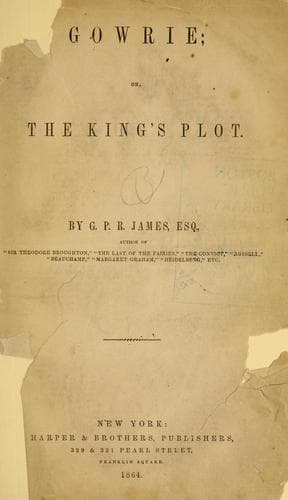
Gowrie; or, the King's Plot.James, G. P. R. (George Payne Rainsford)
General
Gowrie; or, the King's Plot.
James, G. P. R. (George Payne Rainsford)
Gowrie Conspiracy, 1600 -- Fiction
Mr. Rhind, however, though silenced, was not satisfied. He had
listened to the whole conversation with great attention; and combining
what he then heard with words which had at times dropped from both the
earl and Julia, he perceived the nature of the charge against her, and
felt sadly oppressed in mind thereby. It is true he had seen nothing
in her but beauty, sweetness, and rational devotion; he had discovered
that she always carried with her a Bible in the English tongue; but
still fully impressed, as most men were in his day, with a belief that
such a thing as magic really existed, he felt grieved and uneasy on
account of his pupil's long intimacy with Manucci, who, he now found,
had been accused of practising unlawful arts. He tried on the
following morning, by what he thought skilful questions, to extract
more information from Sir John Hume; but he was, by nature, so simple,
that Hume foiled him at every turn by a repartee, and the same night,
eager to hurry on towards Scotland by longer and more rapid journeys
than Julia could undertake, the young knight left his companions to
follow, and hastened on towards France, leaving Mr. Rhind to brood
over his own conclusions with bitterness and apprehension.
CHAPTER XI.
It may seem perhaps a paradox to say that expectation is enjoyment.
Nevertheless it is so on this earth. Fruition is for heaven. With the
accomplishment of every desire, there is so much of disappointment
mingled, that it cannot be really called enjoyment, for fancy always
exercises itself upon the future; and when we obtain the hard reality
for which we wished, the charms with which imagination decorated it
are gone. Did we but state the case to ourselves as it truly is,
whenever we conceive any of the manifold desires which lead us on from
step to step through life, the proposition would be totally different
from that which man for ever puts before his own mind, and we should
take one step towards undeceiving ourselves. We continually say, "if I
could attain such an object, I should be _quite contented_." But what
man ought to say to himself is, "I believe this or that acquisition
would give me happiness." He would soon find that it did not do so;
and the never ceasing recurrence of the lesson might, in the end,
teach him to ask what was the source of his disappointment?--Was it
that other circumstances in his own fate were so altered, even while
he pursued the path of endeavour, as to render attainment no longer
satisfactory?--was it that the object sought was intrinsically
different when attained from that which he had reasonably believed it
to be while pursuing it?--or was it that his fancy had gilded it with
charms not its own, and that he had voluntarily and blindly persuaded
himself that it was brighter and more excellent than it was? Perhaps
the answer, yes, might be returned to all these questions; but yet I
fear the chief burden of deceit would rest with imagination, and that
Public-domain text, read in full here on John Shaqi.
Reviews
Reviews
No reviews yet
Be the first to share your thoughts on this work.
Elsewhere in the archive
Join the Discussion
Join the discussion
Sign in to leave a comment or review.
Sign InorCreate an account