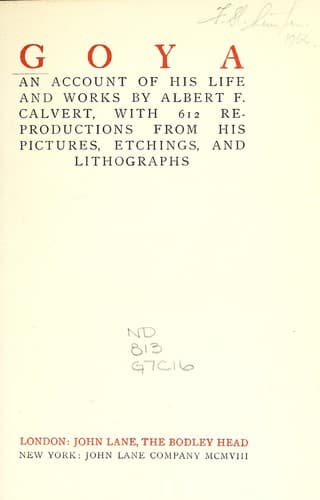
Goya, an account of his life and worksCalvert, Albert Frederick
History
Goya, an account of his life and works
Calvert, Albert Frederick
Goya, Francisco, 1746-1828
‘What madness!’ A monk, surrounded by objects of popular devotion.
69. Nada.
‘Nothing.’ A spectre emerging from the tomb writes the word ‘Nada’ on a
sheet of paper.
70. No saben el camino.
‘They do not know the way.’ A procession of ecclesiastics tied together
by ropes. ‘The blind leading the blind.’
71. Contra el bien general.
‘Against the general good.’ An old man with bat’s ears writing in an
open book. An allusion probably to some unpopular statesman.
72. Las resultas.
‘The consequences.’ The above personage and other vampires drinking the
blood of a corpse, representing Spain.
73. Gatesca pantomima.
‘Cat’s pantomime.’ A monk, birds of prey, and others doing homage to a
cat (Godoy?).
74. Esto es lo peor.
‘This is the worst.’ A wolf signing a document; a monk in attendance.
75. Farándula de charlatanes.
‘Meeting of quacks.’ Monks with heads of asses, parrots, and pigs.
76. El buitre carnivoro.
‘The carnivorous vulture.’ A huge vulture pursued by a crowd of monks
and soldiers.
77. Que se rompe la cuerda.
‘May the rope break.’ King Joseph represented walking on a rope.
78. Se defiende bien.
‘He defends himself well.’ A horse (Spain) defending himself against
wolves.
79. Murió la verdad.
‘Truth died.’ Truth represented as a young woman crowned with laurels.
80. Si resucitará?
‘Will she revive?’ The same figure appearing about to arise from the
grave.
(79 and 80 appear to refer to the abolition of the Constitution by
Fernando VII.)
81. Fiero monstruo.
‘Bold monster.’ An enormous cat devouring human beings.
82. Esto es lo verdadero.
‘There is Truth.’ Truth is represented by a young woman leaning on the
shoulder of a husbandman.
(81 and 82 are not usually included in the series Disasters of War.)
LA TAUROMAQUIA (TAUROMACHIA)
A set of thirty-three prints in aqua-fortis and aqua-tinta finished
about 1815.
1. Hunting Bulls across Open Country in the Olden Time.
2. Hunting the Bull on Foot.
3. Moors hunting the Bull across Country.
4. Moors bull-fighting in an Enclosure.
5. The Moor Gazul is the first to fight the Bull according to modern
rules.
6. Moors using their Burnouses to irritate the Bull.
7. Origin of the Banderilla.
8. Moor attacked by a Bull.
9. Spaniard wearing a Turban killing a Bull in the Arena.
10. Charles V. kills a Bull in the Arena at Valladolid.
11. The Cid spearing a Bull.
12. People hamstringing a Bull.
13. Horseman places some Banderillas without the Help of the Chulos.
14. The Student of Falces, enveloped in his Cape, plays with the Bull.
15. The famous Martincho plants Banderillas.
16. Martincho seizes the Bull by the Tail and the Horns.
17. Moors using Donkeys instead of Horses.
18. Intrepidity of Martincho at Zaragoza.
19. Similar Exploit.
20. Exploit of Juanito Apiñani at Madrid.
21. Spectators killed by the Bull at Madrid.
22. The Woman Picador, Pajuelera, at Zaragoza.
23. Mariano Ceballos in the Arena.
24. Ceballos mounted on a Bull.
Public-domain text, read in full here on John Shaqi.
Reviews
Reviews
No reviews yet
Be the first to share your thoughts on this work.
Elsewhere in the archive
Join the Discussion
Join the discussion
Sign in to leave a comment or review.
Sign InorCreate an account