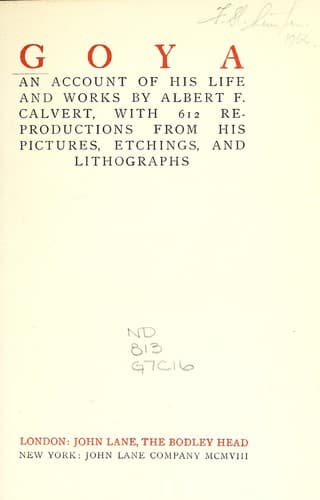
Goya, an account of his life and worksCalvert, Albert Frederick
History
Goya, an account of his life and works
Calvert, Albert Frederick
Goya, Francisco, 1746-1828
Madrid is at once one of the most interesting and most maligned
cities in Europe. It stands at an elevation of 2,500 feet above the
sea leve, in the centre of an arid, treeless, waterless, and
wind-blown plain; but whatever may be thought of the wisdom of
selecting a capital in such a situation, one cannot but admire the
uniqueness of its position, and the magnificence of its buildings,
and one is forced to admit that, having fairly entered the path of
progress, Madrid bids fair to become one of the handsomest and most
prosperous of European cities.
The splendid promenades, the handsome buildings, and the spacious
theatres combine to make Madrid one of the first cities of the
world, and the author has endeavoured with the aid of the camera,
to place every feature and aspect of the Spanish metropolis before
the reader. Some of the illustrations reproduced here have been
made familiar to the English public by reason of the interesting
and stirring events connected with the Spanish Royal Marriage, but
the greater number were either taken by the author, or are the work
of photographers specially employed to obtain new views for the
purpose of this volume.
* * * * *
_UNIFORM WITH THIS VOLUME_
GOYA
A BIOGRAPHY AND APPRECIATION. ILLUSTRATED BY REPRODUCTIONS OF 600 OF HIS
PICTURES
The last of the old masters and the first of the moderns, as he has
been called, Francisco José de Goya y Lucientes is not so
familiarised to English readers as his genius deserves. He was born
at a time when the tradition of Velazquez was fading, and the
condition of Spanish painting was debased almost beyond hope of
salvation; he broke through the academic tradition of imitation;
“he, next to Velazquez, is to be accounted as the man whom the
Impressionists of our time have to thank for their most definite
stimulus, their most immediate inspiration.”
The genius of Goya was a robust, imperious, and fulminating genius;
his iron temperament was passionate, dramatic, and revolutionary;
he painted a picture as he would have fought a battle. He was an
athletic, warlike, and indefatigable painter; a naturalist like
Velazquez; fantastic like Hogarth; eccentric like Rembrandt; the
last flame-coloured flash of Spanish genius.
It is impossible to reproduce his colouring; but in the
reproductions of his works the author has endeavoured to convey to
the reader some idea of Goya’s boldness of style, his mastery of
frightful shadows and mysterious lights, and his genius for
expressing all terrible emotions.
* * * * *
_UNIFORM WITH THIS VOLUME_
CORDOVA
A HISTORICAL AND DESCRIPTIVE ACCOUNT OF THE ANCIENT CITY WHICH THE
CARTHAGINIANS STYLED THE “GEM OF THE SOUTH,” WITH 160 ILLUSTRATIONS
Public-domain text, read in full here on John Shaqi.
Reviews
Reviews
No reviews yet
Be the first to share your thoughts on this work.
Elsewhere in the archive
Join the Discussion
Join the discussion
Sign in to leave a comment or review.
Sign InorCreate an account