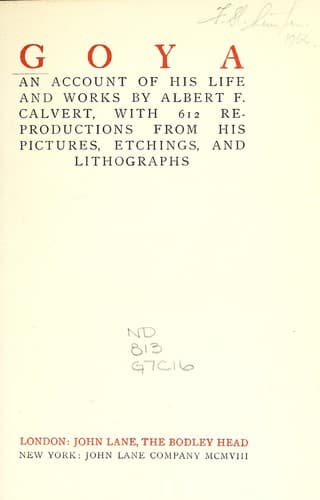
Goya, an account of his life and worksCalvert, Albert Frederick
History
Goya, an account of his life and works
Calvert, Albert Frederick
Goya, Francisco, 1746-1828
The vigour and fire which Gautier finds in this picture is to be
observed in varying degree in all Goya’s works. These qualities were
the results of his temperament, which moved him to fling his ideas upon
the canvas before they could escape him, and imbued him with a constant
desire to be rid of them and at work on something else. ‘His whole art,’
says Muther, ‘seems like a bull-fight; for everywhere he sees before him
some red rag, and hurls himself upon it with the fury of the toro.’ Nor
did his sitters escape the consequences of his impetuosity. Many of his
portraits were painted in a day, but the sitting lasted not a few hours
merely but the whole of the day, during which time, Mr. Rothenstein
tells us, ‘Goya, inexorable towards his model, worked in absolute
silence with extraordinary concentration and vigour.’ The same writer
relates, as an example of his nervousness and irritability in his
studio, the story that the Duke of Wellington so exasperated Goya while
he was painting his portrait by passing comments upon his work while the
picture was in progress, that he took a sword from the wall and forced
his noble sitter to beat a retreat from his studio. Other authorities
state that it was with a pair of pistols that he put the English Duke to
flight. After all, the weapon is not a material point in the story.
A man who worked at this pressure might be expected to develop a
tendency to scamp his work, but while many of Goya’s compositions are
mere sketches, they are all finished according to his theory that ‘a
picture is finished when its effect is true.’ The many compositions Goya
executed for the Countess of Benavente, until recently at the Alameda
Palace, comprised the most representative exhibition of Goya’s genius.
The collection included many pictures painted with exceptional delicacy.
The most important of these pictures, the Romeria de San Isidro, is a
wonderful canvas containing a mass of details which astonish by their
clearness and finish. The ‘Coach attacked by Brigands’ is one example
among many of his skill in catching an instantaneous motion and
transfixing it upon the canvas. Among the Alameda paintings are some
repetitions of the designs for the tapestry factory. The exuberant
gaiety in these pictures is in amazing contrast with the ‘San Bernard’
or the terrifying cartoon of ‘Saturn devouring his Children.’ Goya can
be simple and bizarre, idyllic and grotesque, fascinating and
appalling--his vitality emphasises every facet of his imagination. The
examples of phases of his many-sided vision are inexhaustible. He makes
demons terrible by their humanity, and men and women horrible by their
diabolical sinisterism. He paints you a fête or a funeral, a picnic or a
hanging, with the same facility and artistic assurance; be the mood he
would portray gay or gloomy, the scene brilliant or shuddersome, the
beauty that of a child, a blushing maiden or a dazzling Maja, he never
hesitates, nor does he often come short of success.
Public-domain text, read in full here on John Shaqi.
Reviews
Reviews
No reviews yet
Be the first to share your thoughts on this work.
Join the Discussion
Join the discussion
Sign in to leave a comment or review.
Sign InorCreate an account