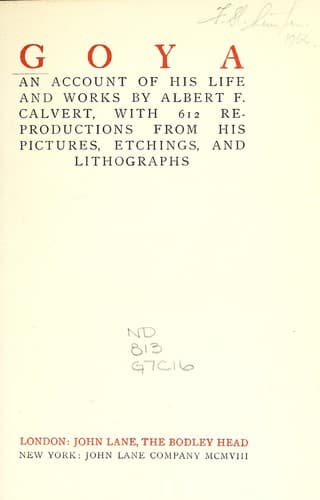
Goya, an account of his life and worksCalvert, Albert Frederick
History
Goya, an account of his life and works
Calvert, Albert Frederick
Goya, Francisco, 1746-1828
In his portraits he is a realist--versatile, vivid, often unflinching in
his brutality, unsurpassed, when he wills it, in perfection of treatment
and intention. His finish is the fulfilment of his purpose, which has
nothing in common with finish in the sense of elaboration. True, many of
his likenesses are ‘washed in with a certain impatience, almost as if
the painter had tired of his subject’ (C. Gasquoine Hartley, in _A
Record of Spanish Painting_); true again, the restlessness of his
temperament made him inclined to seize on a characteristic rendering of
pose and feature: but his portraits reflect the idea in his mind; they
express the always very definite something he has to say; the effect is
true and the picture is finished. It was his method to arrange his
canvas, his model and all his accessories, and then remain wrapped in
profound reflection. When his study of his model was ended he set to
work, either to materialise his inspiration in a swift realisation of a
personality, or to produce a suave, lingering piece of workmanship which
recalls the refinement of Gainsborough in its elaborate, exquisite
detail.
Goya, by virtue of his portraits, has been rightly acclaimed the
legitimate descendant of Velazquez, and, like the great Court painter of
a previous century, he is a magnificent exception. But the comparison
between the two masters cannot be pushed too far. Velazquez was a
realist to whom the world appeared as a beautiful vision; Goya was a
realist to whom life was always a drama and not infrequently a satiric
melodrama played in the tempo of a farce. Velazquez depicted men and
women at their noblest; Goya, when he was in the mood, detected the
worst that was in them and he exposed it with a flourish. The grandeur
of the times which we discern in the portraits of Velazquez is the
grandeur of the artist’s conception and treatment. The equestrian
effigies of Philip III. and Philip IV. reveal the magnificence and
nobility of conscious kingship which neither of the monarchs possessed;
the royal likenesses convey to us a prosperity which impoverished Spain
did not enjoy under the rule of his kingly sitters. Thus it is curious
to find that some critics, but particularly the Conde de la Viñaza,
should see in Goya’s work a similar determination to idealise and
glorify the characters of his royal patrons. ‘The celebrated canvas of
the family of Charles IV.,’ writes Goya’s latest Spanish biographer,
‘together with the equestrian portraits’--the composition of which, as
Mr. Rothenstein reminds us, he may well have learned from Velazquez--‘of
Maria Luisa and her husband, of Ferdinand VII. and Godoy, show forth a
grandeur of mind and intellectual and moral qualities which these people
did not possess. The Godoy represented by Goya as though he were a sort
of Marquis de Pescara, although he never wore his uniform except at sham
fights, recalls the fact that Velazquez also, flattering the ridiculous
Public-domain text, read in full here on John Shaqi.
Reviews
Reviews
No reviews yet
Be the first to share your thoughts on this work.
Join the Discussion
Join the discussion
Sign in to leave a comment or review.
Sign InorCreate an account