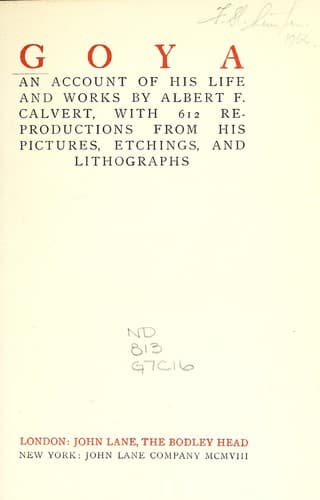
Goya, an account of his life and worksCalvert, Albert Frederick
History
Goya, an account of his life and works
Calvert, Albert Frederick
Goya, Francisco, 1746-1828
Certainly the frescoes in his own day were extolled as the most
important work ever done by Goya’s marvellous brush; he closed the
eighteenth century with creations that won for him his greatest
contemporary fame and raised him to the summit of his art. If nothing
could be further removed from religious inspiration, nothing human could
reveal more enchanting beauty, more exquisite grace. These frescoes were
praised as ‘an inimitable symphony of light and colour.’ It is not in
our province either to accept or to refute the claim that ‘they raise
the most common things of Goya’s time to the high spheres of Spanish
mystic realism.’ Goya’s contemporaries did not realise that the
paintings outraged the canons of propriety and probability, and in later
times Señor Rada finds that the painter, in this work, rises always to
the regions of mystery, where only genius can penetrate, and responds to
the peculiar influence of a temple which seems rather to inspire loving
human aspirations, than mystic thoughts of infinite abstraction. ‘Apart
from the fact that Goya was a believer and respectful to all that
pertained to religion,’ urges Señor Rada, ‘in the principal subject of
this painting (the “Cupola”) he is as manifestly mystic and delicate as
any painter of the spiritual school. In the central group the risen man
partakes of both realism and religious unction. The expression could not
be better, nor could the attitude of the saint be more dignified. Apart
from this in the other groups, he copied what he was wont to observe in
popular gatherings, as he saw it, as it was, as it always will be.’
Goya’s Spanish apologists may well be justified in their contention that
his originality forced him to disregard the classic rules and mannerism
of traditional Spanish religious art. They see no impropriety or
extravagance in surrounding the figure of a revered saint with a crowd
of roysterers, prostitutes, cut-purses and Manzanares rascals. And,
after all, the point is scarcely worth arguing. Again, when it is
protested that Goya’s archangels and seraphim were rather beautiful
women than angelic spirits--well! what better conception could there be
of angels than the perfections of a charming woman? That is Señor Rada’s
retort: ‘The naturalist Goya, surrounded by the seductive beauty of his
time, could not conceive or even presume that the chosen beings who sing
eternal praises in the ethereal regions of celestial glory were any
different. More in accord doubtless, with our pious traditions and with
Christian spiritual belief are the glories of Juan de Juanes and
Murillo; but each artist has his peculiar temperament as well as his
special gamut of colour, and to ask Goya to paint angels like those
great Christian artists would be the same as asking the painters of a
previous epoch to paint pictures of popular scenes like Goya’s.’
Public-domain text, read in full here on John Shaqi.
Reviews
Reviews
No reviews yet
Be the first to share your thoughts on this work.
Elsewhere in the archive
Join the Discussion
Join the discussion
Sign in to leave a comment or review.
Sign InorCreate an account