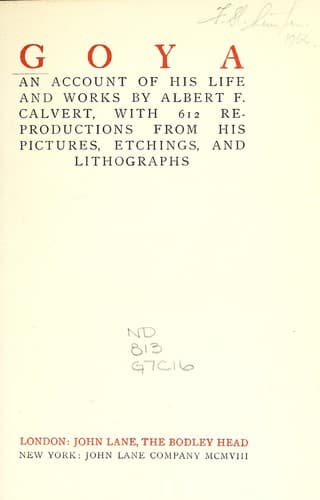
Goya, an account of his life and worksCalvert, Albert Frederick
History
Goya, an account of his life and works
Calvert, Albert Frederick
Goya, Francisco, 1746-1828
‘The frescoes of la Florida,’ comments C. Gasquoine Hartley, ‘are yet
another witness of the truthful humour of Goya’s insight, but not one of
his countrymen realised the irreverent irony of his work.’ ‘The figures
are as full of piquant intention,’ declared Richard Muther, ‘as can be
found in the most erotic paintings of Fragonard.... It is an artistic
_can-can_; it is Casanova transferred to colour. All that the Church
painting of the past had created is despised, forsaken; and this satire
upon the Church and all its works was written in the land of Zurbarán,
of Murillo.’ The Conde de la Viñaza alludes to Goya as an artist who
painted pictures with religious subjects, but not religious pictures. ‘I
do not know,’ he says, ‘a more profane master than this Velazquez,
Rembrandt, Vicelli and Veronese rolled into one.’ And he instances his
monumental painting at la Florida to illustrate his contention: ‘An
admirable energy, the most splendid scale of tones. What relief! What a
magic of colour! What a beautiful lesson the light of nature receives
there! On the other hand, what lack of religious feeling and
spirituality in those frescoes!’ And having denounced in the angels the
silkiness of their skins, the brilliance of their eyes, and the
wantonness of their beauty, he adds, ‘the miracles of the exemplary man
of Padua are familiarly treated as a spectacle of wandering rope-dancers
might be!’
It has been said that the King was incensed against the artist for
introducing renowned ladies of his court in the faces of the winged
archangels, and it is generally believed that the most aristocratic
persons of the capital are represented in the frescoes, but if Charles
IV. resented his choice of models, he had a most amiable way of
expressing his displeasure. Goya himself, writing to Zapater, admitted
that ‘the King and Queen are mad on your friend Goya,’ but the madness
took the form of a royal order, dated October 31, 1799, which reads:
‘H.M. wishing to reward your distinguished merit and to give in person a
testimony that may serve as a stimulus to all professors, of how much he
appreciates your talent and knowledge of the noble art of painting, has
been pleased to appoint you his chief painter of the Chamber, at a
yearly salary of 50,000 reals, which you will receive from this date
free of rights, and also 500 ducats a year for a carriage: and it is
also his pleasure that you occupy the house now inhabited by Don Mariano
Maëlla should he die first,’ etc.
Public-domain text, read in full here on John Shaqi.
Reviews
Reviews
No reviews yet
Be the first to share your thoughts on this work.
Elsewhere in the archive
Join the Discussion
Join the discussion
Sign in to leave a comment or review.
Sign InorCreate an account