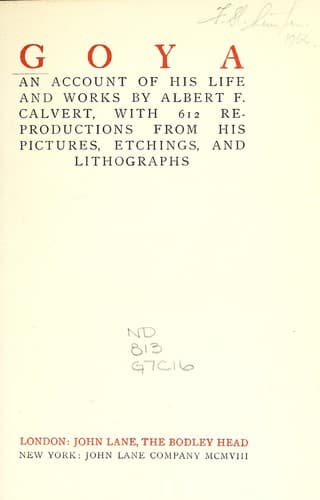
Goya, an account of his life and worksCalvert, Albert Frederick
History
Goya, an account of his life and works
Calvert, Albert Frederick
Goya, Francisco, 1746-1828
Another royal commission entrusted to Goya was to paint episodes of the
war, especially of the siege of Zaragoza. Accompanied by his pupil Luis
Gil Ranz, he set out to obtain studies. Owing to the exaltation of the
populace the journey is said to have abounded in incidents and perils.
The language of signs which Ranz employed in conversing with his deaf
master caused them to be mistaken for spies. They were forced to seek
sanctuary at Renales, the pupil’s native town, where they waited until a
favourable opportunity offered for their return to Madrid.
The melancholy which had settled upon Goya after the accession of the
intrusive King increased with advancing age. In the seclusion of his
house (the house in which he had entertained the noblest of the Court
circle--the Deaf Man’s House, as it came to be called by the Madrileños)
he beguiled the time by painting the walls with fantastic and gruesome
visions which gave it an awesome and startling appearance. But the
brilliant fancy had been obscured by the national vicissitudes he had
witnessed and the haunting memories of the war obsessed his imagination.
These paintings, which are now preserved in the Prado, produce a painful
impression; they would seem to be the creations of a fevered brain.
In 1817 Goya visited Seville to paint the picture of Santas Justa and
Rufina for the Cathedral, to which reference has been made. On his
return he designed a new series of Caprices, and executed many portraits
and miniatures on ivory. It was at this time, too, that he made his
first essay in lithography. The earliest of these lithographs is a fine
brush drawing of an old woman spinning. It is signed and dated February
1819. Among the drawings upon stone that were executed about this
period, the two most important are ‘Los Chiens,’ a bull attacked by
dogs, and the splendid diabolical scene of a man being dragged along by
demons. This last, which is in the Print Room of the British Museum, has
special interest, as it is the first known wash drawing made upon the
stone. M. Lefort mentions six other lithographs which were executed at
Madrid before the journey to France: a duel between two people, a young
woman reading to two children, a monk, a girl sitting on the knee of an
old woman with other women in the background, a drunkard and a woman,
and a peasant assaulting a girl.
Public-domain text, read in full here on John Shaqi.
Reviews
Reviews
No reviews yet
Be the first to share your thoughts on this work.
Elsewhere in the archive
Join the Discussion
Join the discussion
Sign in to leave a comment or review.
Sign InorCreate an account