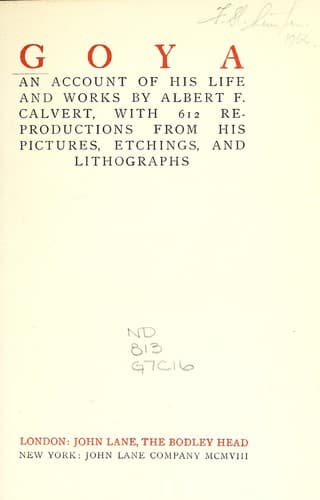
Goya, an account of his life and worksCalvert, Albert Frederick
History
Goya, an account of his life and works
Calvert, Albert Frederick
Goya, Francisco, 1746-1828
Among several unconnected prints we may mention the superb engraving of
‘The Colossus,’ which seems like an etching at first glance and has
defied the attempts of experts to explain the highly complicated process
of its execution. As an illustration of Goya’s resources for producing a
marvellous impression, this piece constitutes a veritable _tour de
force_. The giant is placed in a vast landscape, and beside his uncouth
might and Herculean muscles, cities and villages seem diminutive and
insignificant atoms of the soil on which he rests. He is frightened into
wakefulness by the morning sun which touches his mighty head and
shoulders; they seem as if the summit of a mountain, while his feet are
yet in the shadow of night. A mysterious, pale, fantastic effect of
moonlight throws a peculiar atmosphere about the figure. As we have
already remarked, the process by which the effect is obtained remains
inexplicable. According to a statement made by Goya’s grandson, the
engraver employed a very soft metal plate from which only three
impressions could be taken. One of these impressions is in the National
Library of Madrid. A brilliant and rare old engraving of ‘A Blind Guitar
Player,’ a large but inferior plate of a popular scene, and three
etchings of religious subjects, complete the list of Goya’s
miscellaneous etchings.
In June 1824, at the age of seventy-six, Goya set out for France. Before
starting he painted his ‘San José de Calasanz receiving the
Sacrament’--perhaps his finest religious composition. The work was
scarcely dry when he sought and obtained the King’s permission to take
the mineral waters at Plombières in France. The remainder of his life’s
story is soon told. In Paris he made the personal acquaintance of
Vernet, and found delight in the works of Gros, of Géricault, and of
Delacroix. The last master did honour to Goya by copying every plate of
the ‘Caprichos.’ But the full life of Paris was too overwhelming for
the old painter, and having obtained in January 1825 a six months’
extension of leave from the King, he settled down in Bordeaux with his
devoted friends, Mme. Weiss and her daughter. In the little Spanish
colony on the pleasant banks of the Garonne, he had for companions
Joseph de Carnerero, the marine painter, Antonio de Brugada, the members
of the family of Goicoechea, and Pio de Molina, and Moratin, whose
portraits he painted. But these pictures do not represent his full
powers; the colours are heavy and sometimes crude; he worked with double
magnifying glasses and a stout lens. But in his engraving, and
especially in his series of lithographs, ‘Les Taureaux de Bordeaux,’
which Mr. Rothenstein describes as ‘the most remarkable compositions of
his life, certainly the greatest and most significant lithographs in the
history of the art,’ his old powers shine forth again in undimmed
brilliance.
Public-domain text, read in full here on John Shaqi.
Reviews
Reviews
No reviews yet
Be the first to share your thoughts on this work.
Elsewhere in the archive
Join the Discussion
Join the discussion
Sign in to leave a comment or review.
Sign InorCreate an account