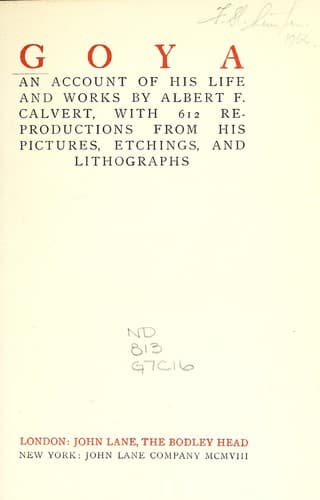
Goya, an account of his life and worksCalvert, Albert Frederick
History
Goya, an account of his life and works
Calvert, Albert Frederick
Goya, Francisco, 1746-1828
15. The Inquisition: Judges, Monks, and Condemned.
The Royal Museum, Brussels.
16. Dungeon of the Inquisition.
The Bowes Museum, Barnard Castle, England.
17. Monk flogging a Woman; several Onlookers.
Don José de la Bastida, Madrid.
18. The Flagellants.
A procession of penitents advancing in order and scourging each other.
Academia de San Fernando, Madrid.
19. The Garotte.
Clothed in a san-benito, the criminal has just expired. A crowd,
horrified.
Museum, Lille.
20. The Pilgrimage to Lombas.
Sold in Paris, 1875.
21. The Procession.
Monks and pilgrims traversing a barren country.
Conde de Candilla, Madrid.
22. Hannibal surveying Italy from the Apennines.
This picture earned for Goya the second prize offered by the Academy of
Parma in 1772.
VARIOUS SUBJECTS
1. Venus.
Mentioned by the Conde de la Viñaza as forming part of Godoy’s
collection at Madrid.
2 and 3. The Madhouse.
Academia de San Fernando, Madrid, and copy in the collection of Don A.
de Beruete, Madrid.
4. ‘La Maja Vestida’ and ‘La Maja Denuda.’
The two famous pictures in the Academy of San Fernando at Madrid are
regarded as portraying a favourite of Manuel Godoy, the ‘Prince of the
Peace’; others maintain that they are portraits of the painter’s
mistress. Both paintings are from the same model. The one represents a
young and beautiful woman reclining at full length upon a couch, her
shoulders sustained by soft cushions, her head somewhat advanced by her
hand crossed at the back of her neck, the upper part of the left arm
supported by the cushions. Her lustrous, expressive eyes are turned
towards the spectator. She is habited in Oriental costume, a diaphanous
yellow vest, and clinging skirt beneath, of tender rose colour,
revealing the contour of the lower limbs.
The second figure is entirely nude, and in precisely the same attitude
as the companion picture. Relieved of the head-dress, her curling
tresses fall luxuriantly about her shoulders; the lace-bedecked pillows
and drapery upon the couch in charming contrast with the lovely
flesh-tints. In short, these life-size figures are amongst the choicest
examples of the master. Had Goya always painted thus it had been vain to
blame, and useless to praise him.
5. The Majas of the Balcony.
Two young women are seated on a balcony, one in a white robe with black
mantilla, the other in a dark dress with white mantilla. Behind them two
attendant cavaliers.
Duque de Marchena, Madrid.
6. The Majas of the Balcony.
Repetition of foregoing with variations.
Comtesse de Paris.
7. The Majas of the Balcony.
Repetition.
Formerly at Salamanca. Bought in Paris, 1875, by ‘C.G.’
8. The Majas at the Theatre.
In the front of a box three young ladies are seated; a gentleman
standing behind.
Don Joaquin Miguel y Polo, Valencia. Doubtful.
9. A Cavalier playing the Guitar.
The Prado, Madrid.
10. A Cavalier.
He is represented smoking a cigarette. A lace frill about his neck; a
black cape is thrown across his left shoulder.
Public-domain text, read in full here on John Shaqi.
Reviews
Reviews
No reviews yet
Be the first to share your thoughts on this work.
Elsewhere in the archive
Join the Discussion
Join the discussion
Sign in to leave a comment or review.
Sign InorCreate an account