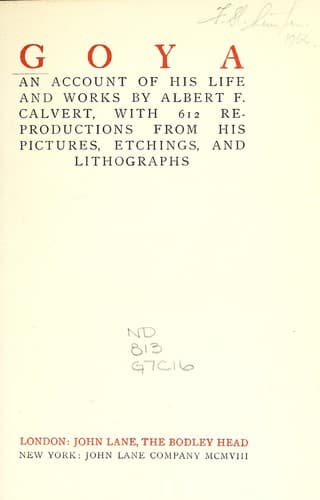
Goya, an account of his life and worksCalvert, Albert Frederick
History
Goya, an account of his life and works
Calvert, Albert Frederick
Goya, Francisco, 1746-1828
31. Bandits.
Two women are supplicating brigands to spare their lives; a third is
lying dead.
In this picture the colour is said to be wholly laid on with a knife.
Mentioned by Z. Aranjo.
32. Brigands stopping a Carriage.
Marqués de Riscal, Madrid. Doubtful.
33. Brigands.
A brigand is holding a woman to the ground; a monk, inactive, is
contemplating the scene. In the background, two women, stripped, are
tied to trees.
Formerly in possession of Don Constantino Ardanaz. Mentioned by Aranjo.
34. Brigands.
A kneeling woman struggling with a bandit. In the distance two bandits
are carrying a dead woman.
Formerly in the possession of Don Constantino Ardanaz, Madrid. Mentioned
by Aranjo.
35. Brigands.
At the entrance to a cave a bandit is murdering a woman bound to a rock.
Marqués de la Romana, Madrid.
36. Brigands.
Slaughter of a group of men, women, and children.
Marqués de la Romana, Madrid.
37. Brigands’ Cave.
In the cave, brigands are stripping women whom they have captured.
Marqués de la Romana, Madrid.
38. Brigands’ Cave.
A brigand slaughtering a woman.
Marqués de la Romana, Madrid.
39. Brigands’ Cave.
Bandits asleep.
Marqués de la Romana, Madrid.
40. The Promenade.
A lady and gentleman conversing as they walk. Tradition has it that the
two persons represented are the Duquesa de Alba y Goya.
Marqués de la Romana, Madrid.
41. The Plague Terror.
The stricken ones, stretched upon the ground, are tended by scared
doctors.
Marqués de la Romana, Madrid.
42. Interior.
Several women have met together for a gossip.
Marqués de la Romana, Madrid.
43. The Monk’s Visit.
A monk and a young woman.
Marqués de la Romana, Madrid.
44. Brigands Quarrelling.
Museum, Besançon.
45. Brigands Quarrelling.
An old man, seated, is looking on.
Museum, Besançon.
46. A Cannibal Scene.
Eight men are gathered round a fire; one is grinning, and holding in his
right hand a human arm, in his left a head. His companions, naked like
himself, are engaged in the orgie.
Museum, Besançon.
47. A Cannibal Scene.
At the foot of a cliff men occupied in stripping and carving corpses.
Museum, Besançon.
48. The Funeral of the Sardine.
An episode at the close of the carnival at Madrid. Men and women are
masquerading on the banks of the Manzanares.
Academia de San Fernando, Madrid.
49. A Carnival Scene.
Masked figures dance extravagantly at the entrance of a cave.
M. Ch. Cherfils, Biarritz.
50. A Carnival Scene.
A singer entertaining his audience.
Museum, Bayonne. Doubtful.
51. A Masquerade.
In the foreground two principal figures are dancing; others engaged in
flirtation and conversation.
Duquesa de Villahermosa, Madrid.
52. Children’s Masquerade.
Don Patricio Lozano, Madrid.
53. Bal Champêtre.
Groups of peasants dancing under an arch.
Mentioned by Aranjo.
54. Bal Champêtre.
A village population dancing; spectators on a hill.
Paris.
55. Bal Champêtre.
Same subject as Goya’s tapestry cartoon.
Conde de Torrecilla, Madrid.
Public-domain text, read in full here on John Shaqi.
Reviews
Reviews
No reviews yet
Be the first to share your thoughts on this work.
Elsewhere in the archive
Join the Discussion
Join the discussion
Sign in to leave a comment or review.
Sign InorCreate an account