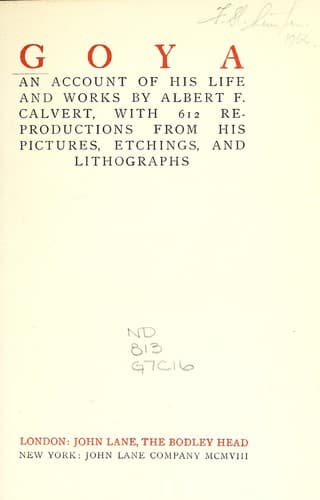
Goya, an account of his life and worksCalvert, Albert Frederick
History
Goya, an account of his life and works
Calvert, Albert Frederick
Goya, Francisco, 1746-1828
‘A dream of falsehood and inconstancy.’ In the collection of Don V.
Carderera.
82. Women lamenting, while a Man gives a Dog some Medicine.
Very rare.
83. Woman sleeping in a Prison, her Feet chained to the Wall.
Very rare.
THE DISASTERS OF WAR
A set of eighty prints in aqua-tinta. Published by the Academia de San
Fernando in 1863:--
1. Tristes presentimientos....
‘Sad presentiments.’ An emaciated man, symbolical of the Spanish people,
kneels in a supplicating attitude, and regards the sky, which is filled
with portentous monsters.
2. Con razón ó sin ella.
‘With or without reason.’ Two peasants attacking French troops.
3. Lo mismo.
‘All the same.’ Similar subject.
4. Las mujeres dan valor.
‘Women inspire courage.’ Women resisting soldiers.
5. Y son fieras.
‘And are like wild beasts.’ Similar subject.
6. Bien te se está.
‘A good thing.’ French soldiers dying.
7. Que valor!
‘Courage!’ The Maid of Zaragoza.
8. Siempre sucede.
‘What always happens.’ French soldiers put to flight.
9. No quieren.
‘They will not.’ Women resisting soldiers.
10. Tampoco.
‘Nor they.’ Similar subject.
11. Ni por esas.
‘Not for these.’ Similar subject.
12. Para eso habeis nacido?
‘Were you born for this?’ Man falls dying on a heap of slain.
13. Amarga presencia.
‘A bitter sight.’ Woman witnessing maltreatment of her husband by
soldiers.
14. Duro es el paso.
‘Hard is the way.’ Hanging of prisoners.
15. Y no hay remedio.
‘And there was no remedy.’ Execution of prisoners.
16. Se aprovechar.
‘They avail themselves.’ Troops stripping the slain.
17. No se convienen.
‘They do not agree.’ Battle piece. Dispute between French officers.
18. Enterrar y callar.
‘Bury and be silent.’ Weeping man and woman gaze on a heap of slain.
19. Ya no hay tiempo.
‘There is no time.’ Fruitless appeal by women to a French officer.
20. Curarlos y a otra.
‘To heal them and each other.’ Wounded guerrillas.
21. Será lo mismo.
‘It will be the same.’ Wounded men; woman weeping.
22. Tanto y más.
‘As many and more.’ Heap of slain.
23. Lo mismo en otras partes.
‘The same elsewhere.’ Similar subject.
24. Aun podrán servir.
‘They are still of use.’ Sick people carrying the wounded.
25. Tambien estos.
‘And there also.’ Wounded in an ambulance.
26. No se puede mirar.
‘That cannot be seen.’ People lying on the ground threatened by the
muskets of the troops.
27. Caridad.
‘Charity.’ Corpses being thrown into a ditch.
28. Populacho.
‘The populace.’ Mutilating a corpse.
29. Lo merecia.
‘He deserved it.’ Soldier’s body being dragged by cords.
30. Estragos de la guerra.
‘The tragedy of war.’ Men and women projected headlong into a cellar.
31. Fuerte cosa es!
‘Might is stronger than right!’ Prisoners being hanged by the French.
32. Por qué?
‘Why?’ Prisoner being tortured by three soldiers.
33. Que hay que hacer mas?
‘What more is there to do?’ Similar subject.
34. Por una navaja.
‘For a knife.’ Corpse of executed assassin on a scaffold.
Public-domain text, read in full here on John Shaqi.
Reviews
Reviews
No reviews yet
Be the first to share your thoughts on this work.
Elsewhere in the archive
Join the Discussion
Join the discussion
Sign in to leave a comment or review.
Sign InorCreate an account