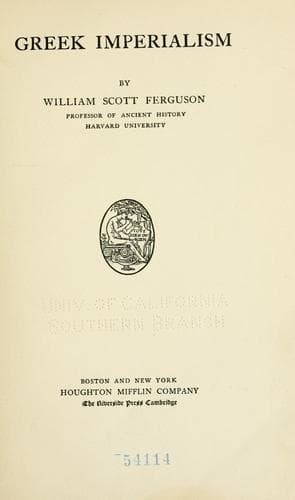
Greece -- History; Greece -- Politics and government; Imperialism
were forced to acknowledge its justice.
They constituted their territorial army more and more from native
soldiers, to whom they gave increasingly larger lots, while they
progressively diminished the size of those held by the foreigners. They
ceased to take back the holdings on the death or superannuation of the
occupants, thus admitting the right of sons and other male descendants
to get, in return for military service, not dry or marsh land, as in
the early days, but land already redeemed by their father's capital and
labor. Soldiers ceased to be soldiers spending their spare time winning
new land from the desert and the swamp for their master's estate; and
became farmers to whom service in the army was a nuisance and a loss.
The army became thereby hopelessly immobile.
The age was generally one of economic decline and not of economic
advance; for Egypt had gained more, as the sequel proved, from the
vigorous government of the early Ptolemies than it had lost by the
expenditure of its surpluses on the empire. In this decadent age the
Egyptians gained admission freely to the police and administrative
service as well as to the army. Thus elevated in social esteem,
they were able to intermarry with their ancient lords; so that a
considerable half-breed and bilingual population developed--Greek in
the outward things, fellaheen, according to Polybius, in character and
culture. Alexandria, he says,[100] "three strata occupy: the Egyptian
and the native race, sharp and (un)civilized. Then the mercenary
troops, oppressive and numerous and dissolute; for from old custom
they kept armed troops who had learned to rule rather than to obey, on
account of the worthlessness of the kings. The third stratum was that
of the Alexandrians, nor was even this truly a civilized population
owing to the same causes, but yet better than the other two, for though
of mixed breed, yet they were originally Greeks, with traditions of
the general type of the Greeks. But this part of the population having
disappeared mainly owing to Ptolemy Euergetes Physkon (145-116 B.C.) in
whose reign Polybius visited Alexandria,--for Physkon, when revolted
against, over and over again let loose his troops on the population and
massacred them,--and such being the state of things, to visit Egypt was
a long and thankless journey." Foreign enemies the omnipotent Roman
Senate kept off during the second century B.C.
But unnerved by the menacing patronage of the great republic, the
Ptolemies, now represented by men of vigor and no character or of
character and no vigor; by women, who were sprung mostly from adelphic
unions, of remarkable ability, beauty, and morals, prefaced with a
period of long-continued dynastic and national strife the dramatic
epoch of Ptolemy the Piper and Cleopatra the Great.
SELECT BIBLIOGRAPHY
1. Mahaffy, J.P. _The Empire of the Ptolemies_ (1895), and _The
Ptolemaic Dynasty_ (1899).
2. Beloch, J. _Griechische Geschichte_, III (1904).
Public-domain text, read in full here on John Shaqi.
Reviews
Reviews
No reviews yet
Be the first to share your thoughts on this work.
Elsewhere in the archive
Join the Discussion
Join the discussion
Sign in to leave a comment or review.
Sign InorCreate an account