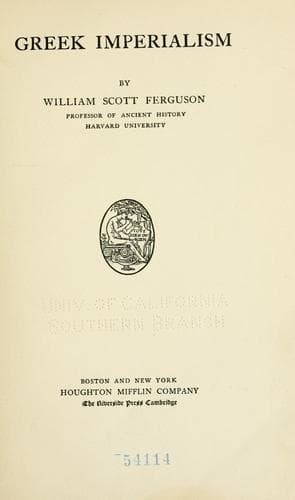
Greece -- History; Greece -- Politics and government; Imperialism
Rome suffered more from the Antigonids than from any other Hellenistic
dynasty because it had there alone to do with a nation of veterans
under arms. The Macedonians were, as has been said, an imperial people,
loyal to their kings, and ambitious to maintain their ascendancy in
the world. While at war with Rome--the wielder of armies 100,000
strong--they were assailed simultaneously by their Hellenic vassals
and rivals and attacked or abandoned by their Macedonian kinsmen
in Asia and Africa; yet they held out under the Antigonids, in the
first struggle for eight years (212-205 B.C.), in the second for four
(200-197 B.C.), in the third for still another four (171-168 B.C.); and
even after one half of their men of military age had fallen at Pydna,
and their last king had died in captivity and his only son as a clerk
at Alba Fucens, their conquerors were so seriously disturbed by the
"throbbings of their ancient loyalty" that the Senate had finally to
place a Roman proconsul on the throne of the great Alexander (148 B.C.).
* * * * *
Though sprung from a Macedonian stock, the dynasty of the Antigonids
was bred in Asia, and it was transplanted into Macedon only in its
third generation. That came about in the following way. The first
Antigonus was made ruler of Phrygia when Alexander the Great left Asia
Minor in 333 B.C., and he was still in possession of that satrapy when
his sovereign died ten years later. With Phrygia as a starting point
and a nomination as commander-in-chief of the royal forces in Asia as
a pretext, he planned and fought with such success in the next decade
that in the spring of 312 B.C. he seemed destined to add Macedon to
Asia, which he already possessed; and with it to support and not to
oppose him, he counted on being able to master the whole of Alexander's
empire. We have already seen why this project failed, and also how a
later attempt to accomplish the same purpose cost him his life and his
Asiatic realm. He may have been over-ambitious. Possibly no one could
have prevented the dismemberment of the Græco-Macedonian world. Perhaps
the centrifugal tendencies would have proved too strong for Alexander
himself had he lived long enough to test them. That, however, does
not make the issue less of a calamity for the Hellenes; for on the
battle-fields of Gaza and Ipsus it was decided that the alien Romans
and not the kindred Macedonians were to unite the world under a single
government. With the person of the first Antigonus went to the grave
the hope of a great people.
Public-domain text, read in full here on John Shaqi.
Reviews
Reviews
No reviews yet
Be the first to share your thoughts on this work.
Elsewhere in the archive
Join the Discussion
Join the discussion
Sign in to leave a comment or review.
Sign InorCreate an account