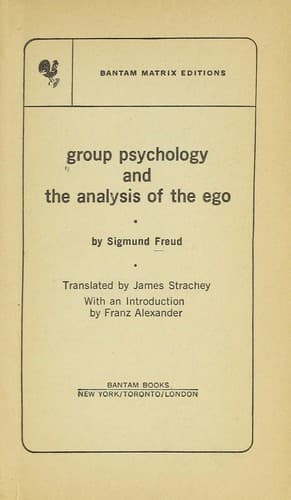
Group Psychology and The Analysis of The EgoFreud, Sigmund
Science
Group Psychology and The Analysis of The Ego
Freud, Sigmund
Ego (Psychology); Psychoanalysis; Social psychology
By the measures that he takes, then, the hypnotist awakens in the
subject a portion of his archaic inheritance which had also made him
compliant towards his parents and which had experienced an individual
re-animation in his relation to his father; what is thus awakened is the
idea of a paramount and dangerous personality, towards whom only a
passive-masochistic attitude is possible, to whom one's will has to be
surrendered,--while to be alone with him, 'to look him in the face',
appears a hazardous enterprise. It is only in some such way as this that
we can picture the relation of the individual member of the primal horde
to the primal father. As we know from other reactions, individuals have
preserved a variable degree of personal aptitude for reviving old
situations of this kind. Some knowledge that in spite of everything
hypnosis is only a game, a deceptive renewal of these old impressions,
may however remain behind and take care that there is a resistance
against any too serious consequences of the suspension of the will in
hypnosis.
The uncanny and coercive characteristics of group formations, which are
shown in their suggestion phenomena, may therefore with justice be
traced back to the fact of their origin from the primal horde. The
leader of the group is still the dreaded primal father; the group still
wishes to be governed by unrestricted force; it has an extreme passion
for authority; in Le Bon's phrase, it has a thirst for obedience. The
primal father is the group ideal, which governs the ego in the place of
the ego ideal. Hypnosis has a good claim to being described as a group
of two; there remains as a definition for suggestion--a conviction which
is not based upon perception and reasoning but upon an erotic tie.[60]
XI
A DIFFERENTIATING GRADE IN THE EGO
If we survey the life of an individual man of to-day, bearing in mind
the mutually complementary accounts of group psychology given by the
authorities, we may lose the courage, in face of the complications that
are revealed, to attempt a comprehensive exposition. Each individual is
a component part of numerous groups, he is bound by ties of
identification in many directions, and he has built up his ego ideal
upon the most various models. Each individual therefore has a share in
numerous group minds--those of his race, of his class, of his creed, of
his nationality, etc.--and he can also raise himself above them to the
extent of having a scrap of independence and originality. Such stable
and lasting group formations, with their uniform and constant effects,
are less striking to an observer than the rapidly formed and transient
groups from which Le Bon has made his brilliant psychological character
sketch of the group mind. And it is just in these noisy ephemeral
groups, which are as it were superimposed upon the others, that we are
met by the prodigy of the complete, even though only temporary,
disappearance of exactly what we have recognized as individual
acquirements.
Public-domain text, read in full here on John Shaqi.
Reviews
Reviews
No reviews yet
Be the first to share your thoughts on this work.
Join the Discussion
Join the discussion
Sign in to leave a comment or review.
Sign InorCreate an account