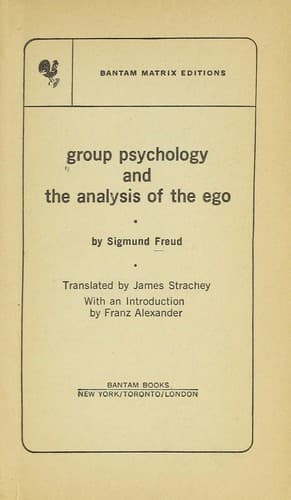
Group Psychology and The Analysis of The EgoFreud, Sigmund
Science
Group Psychology and The Analysis of The Ego
Freud, Sigmund
Ego (Psychology); Psychoanalysis; Social psychology
We have interpreted this prodigy as meaning that the individual gives up
his ego ideal and substitutes for it the group ideal as embodied in the
leader. And we must add by way of correction that the prodigy is not
equally great in every case. In many individuals the separation between
the ego and the ego ideal is not very far advanced; the two still
coincide readily; the ego has often preserved its earlier
self-complacency. The selection of the leader is very much facilitated
by this circumstance. He need only possess the typical qualities of the
individuals concerned in a particularly clearly marked and pure form,
and need only give an impression of greater force and of more freedom of
libido; and in that case the need for a strong chief will often meet him
half-way and invest him with a predominance to which he would otherwise
perhaps have had no claim. The other members of the group, whose ego
ideal would not, apart from this, have become embodied in his person
without some correction, are then carried away with the rest by
'suggestion', that is to say, by means of identification.
We are aware that what we have been able to contribute towards the
explanation of the libidinal structure of groups leads back to the
distinction between the ego and the ego ideal and to the double kind of
tie which this makes possible--identification, and substitution of the
object for the ego ideal. The assumption of this kind of differentiating
grade [_Stufe_] in the ego as a first step in an analysis of the ego
must gradually establish its justification in the most various regions
of psychology. In my paper 'Zur Einführung des Narzissmus' I have put
together all the pathological material that could at the moment be used
in support of this separation. But it may be expected that when we
penetrate deeper into the psychology of the psychoses its significance
will be discovered to be far greater. Let us reflect that the ego now
appears in the relation of an object to the ego ideal which has been
developed out of it, and that all the interplay between an outer object
and the ego as a whole, with which our study of the neuroses has made us
acquainted, may possibly be repeated upon this new scene of action
inside the ego.
Public-domain text, read in full here on John Shaqi.
Reviews
Reviews
No reviews yet
Be the first to share your thoughts on this work.
Elsewhere in the archive
Join the Discussion
Join the discussion
Sign in to leave a comment or review.
Sign InorCreate an account