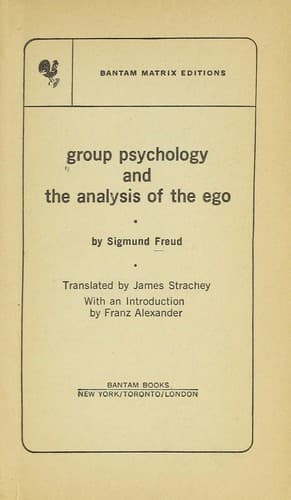
Group Psychology and The Analysis of The EgoFreud, Sigmund
Science
Group Psychology and The Analysis of The Ego
Freud, Sigmund
Ego (Psychology); Psychoanalysis; Social psychology
It was then, perhaps, that some individual, in the exigency of his
longing, may have been moved to free himself from the group and take
over the father's part. He who did this was the first epic poet; and the
advance was achieved in his imagination. This poet disguised the truth
with lies in accordance with his longing. He invented the heroic myth.
The hero was a man who by himself had slain the father--the father who
still appeared in the myth as a totemistic monster. Just as the father
had been the boy's first ideal, so in the hero who aspires to the
father's place the poet now created the first ego ideal. The transition
to the hero was probably afforded by the youngest son, the mother's
favourite, whom she had protected from paternal jealousy, and who, in
the era of the primal horde, had been the father's successor. In the
lying poetic fancies of prehistoric times the woman, who had been the
prize of battle and the allurement to murder, was probably turned into
the seducer and instigator to the crime.
The hero claims to have acted alone in accomplishing the deed, which
certainly only the horde as a whole would have ventured upon. But, as
Rank has observed, fairy tales have preserved clear traces of the facts
which were disavowed. For we often find in them that the hero who has to
carry out some difficult task (usually a youngest son, and not
infrequently one who has represented himself to the father surrogate as
being stupid, that is to say, harmless)--we often find, then, that this
hero can carry out his task only by the help of a crowd of small
animals, such as bees or ants. These would be the brothers in the primal
horde, just as in the same way in dream symbolism insects or vermin
signify brothers and sisters (contemptuously, considered as babies).
Moreover every one of the tasks in myths and fairy tales is easily
recognisable as a substitute for the heroic deed.
The myth, then, is the step by which the individual emerges from group
psychology. The first myth was certainly the psychological, the hero
myth; the explanatory nature myth must have followed much later. The
poet who had taken this step and had in this way set himself free from
the group in his imagination, is nevertheless able (as Rank has further
observed) to find his way back to it in reality. For he goes and relates
to the group his hero's deeds which he has invented. At bottom this hero
is no one but himself. Thus he lowers himself to the level of reality,
and raises his hearers to the level of imagination. But his hearers
understand the poet, and, in virtue of their having the same relation of
longing towards the primal father, they can identify themselves with the
hero.[68]
Public-domain text, read in full here on John Shaqi.
Reviews
Reviews
No reviews yet
Be the first to share your thoughts on this work.
Elsewhere in the archive
Join the Discussion
Join the discussion
Sign in to leave a comment or review.
Sign InorCreate an account