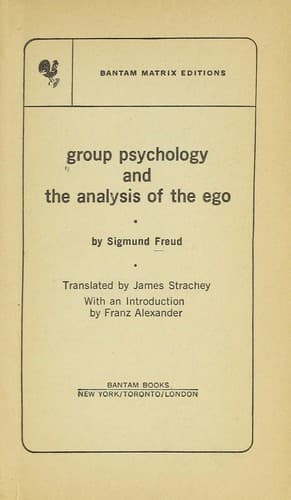
Group Psychology and The Analysis of The EgoFreud, Sigmund
Science
Group Psychology and The Analysis of The Ego
Freud, Sigmund
Ego (Psychology); Psychoanalysis; Social psychology
Wie er räuspert und wie er spuckt,
Das habt ihr ihm glücklich abgeguckt![66]
It is otherwise in the Catholic Church. Every Christian loves Christ as
his ideal and feels himself united with all other Christians by the tie
of identification. But the Church requires more of him. He has also to
identify himself with Christ and love all other Christians as Christ
loved them. At both points, therefore, the Church requires that the
position of the libido which is given by a group formation should be
supplemented. Identification has to be added where object-choice has
taken place, and object love where there is identification. This
addition evidently goes beyond the constitution of the group. One can be
a good Christian and yet be far from the idea of putting oneself in
Christ's place and of having like him an all-embracing love for mankind.
One need not think oneself capable, weak mortal that one is, of the
Saviour's largeness of soul and strength of love. But this further
development in the distribution of libido in the group is probably the
factor upon which Christianity bases its claim to have reached a higher
ethical level.
B. We have said that it would be possible to specify the point in the
mental development of man at which the advance from group to individual
psychology was also achieved by the individual members of the group.[67]
For this purpose we must return for a moment to the scientific myth of
the father of the primal horde. He was later on exalted into the creator
of the world, and with justice, for he had produced all the sons who
composed the first group. He was the ideal of each one of them, at once
feared and honoured, a fact which led later to the idea of taboo. These
many individuals eventually banded themselves together, killed him and
cut him in pieces. None of the group of victors could take his place,
or, if one of them did, the battles began afresh, until they understood
that they must all renounce their father's heritage. They then formed
the totemistic community of brothers, all with equal rights and united
by the totem prohibitions which were to preserve and to expiate the
memory of the murder. But the dissatisfaction with what had been
achieved still remained, and it became the source of new developments.
The persons who were united in this group of brothers gradually came
towards a revival of the old state of things at a new level. Man became
once more the chief of a family, and broke down the prerogatives of the
gynaecocracy which had become established during the fatherless period.
As a compensation for this he may at that time have acknowledged the
mother deities, whose priests were castrated for the mother's
protection, after the example that had been given by the father of the
primal horde. And yet the new family was only a shadow of the old one;
there were numbers of fathers and each one was limited by the rights of
the others.
Public-domain text, read in full here on John Shaqi.
Reviews
Reviews
No reviews yet
Be the first to share your thoughts on this work.
Elsewhere in the archive
Join the Discussion
Join the discussion
Sign in to leave a comment or review.
Sign InorCreate an account