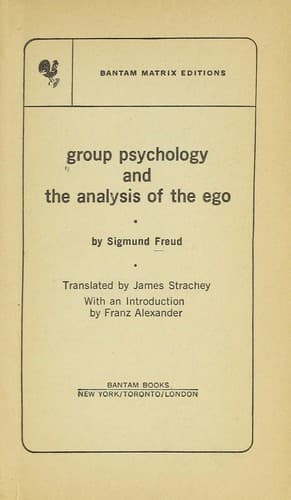
Group Psychology and The Analysis of The EgoFreud, Sigmund
Science
Group Psychology and The Analysis of The Ego
Freud, Sigmund
Ego (Psychology); Psychoanalysis; Social psychology
[25] Nachmansohn: 'Freuds Libidotheorie verglichen mit der Eroslehre
Platos'. _Internationale Zeitschrift für Psychoanalyse_, 1915, Bd. III;
Pfister: 'Plato als Vorläufer der Psychoanalyse', ibid., 1921, Bd. VII.
['Plato: a Fore-Runner of Psycho-Analysis'. _International Journal of
Psycho-Analysis_, 1922, Vol. III.]
[26] 'Though I speak with the tongues of men and of angels, and have not
love, I am become as sounding brass, or a tinkling cymbal.'
[27] [An idiom meaning 'for their sake'. Literally: 'for love of
them'.--_Translator._]
[28] An objection will justly be raised against this conception of the
libidinal [see next foot-note] structure of an army on the ground that
no place has been found in it for such ideas as those of one's country,
of national glory, etc., which are of such importance in holding an army
together. The answer is that that is a different instance of a group
tie, and no longer such a simple one; for the examples of great
generals, like Caesar, Wallenstein, or Napoleon, show that such ideas
are not indispensable to the existence of an army. We shall presently
touch upon the possibility of a leading idea being substituted for a
leader and upon the relations between the two. The neglect of this
libidinal factor in an army, even when it is not the only factor
operative, seems to be not merely a theoretical omission but also a
practical danger. Prussian militarism, which was just as unpsychological
as German science, may have had to suffer the consequences of this in
the great war. We know that the war neuroses which ravaged the German
army have been recognized as being a protest of the individual against
the part he was expected to play in the army; and according to the
communication of E. Simmel (_Kriegsneurosen and 'Psychisches Trauma'._
Munich, 1918), the hard treatment of the men by their superiors may be
considered as foremost among the motive forces of the disease. If the
importance of the libido's claims on this score had been better
appreciated, the fantastic promises of the American President's fourteen
points would probably not have been believed so easily, and the splendid
instrument would not have broken in the hands of the German leaders.
[29] [Here and elsewhere the German 'libidinös' is used simply as an
adjectival derivative from the technical term '_Libido_'; 'libidinal' is
accordingly introduced in the translation in order to avoid the
highly-coloured connotation of the English 'libidinous'.--_Translator._]
Public-domain text, read in full here on John Shaqi.
Reviews
Reviews
No reviews yet
Be the first to share your thoughts on this work.
Elsewhere in the archive
Join the Discussion
Join the discussion
Sign in to leave a comment or review.
Sign InorCreate an account